

Purpose-built shopping centres may be a thing of the past as cities around the world focus on feel-good, mixed-use precincts powered by public and private investment. That’s the headline from three experts who shared insights at the ‘Think International Precincts’ event held at Sydney’s Locomotive Workshop in August.
Hosted by global design practice Buchan, the event offered lessons for Australian developers looking to create thriving urban precincts of the future. Here are three takeaways from the event.

The ‘Think International Precincts’ event at the Locomotive Workshop (by Sissons Architects with
Buchan and Mirvac Design, and Curio Projects). Image: Alice Boshall
Feel-good places aren’t just about spending
Good precincts are places where people want to spend their valuable spare time, not just their money, says Phil Schoutrop, architect and precinct sector lead at Buchan.
“People are looking for an experience. They’re looking for a good time, not just the purchase of goods,” he says.
Diversity of amenity and experience is key, alongside inclusivity, making places where everyone feels comfortable.
“New precincts blur the lines between retail, leisure and commercial to create a feel-good place where people want to be. It’s a matter of doing the research and understanding the customer’s lifestyle. You get that right and it becomes a destination people want to come back to,” says Schoutrop.
An example he cites is Sydney’s heritage Locomotive Workshops, which was repurposed as a mixed-use precinct that doubles as a living museum. The site’s industrial and social history has been seamlessly woven into hospitality, retail and commercial tenancies and surrounding public spaces.
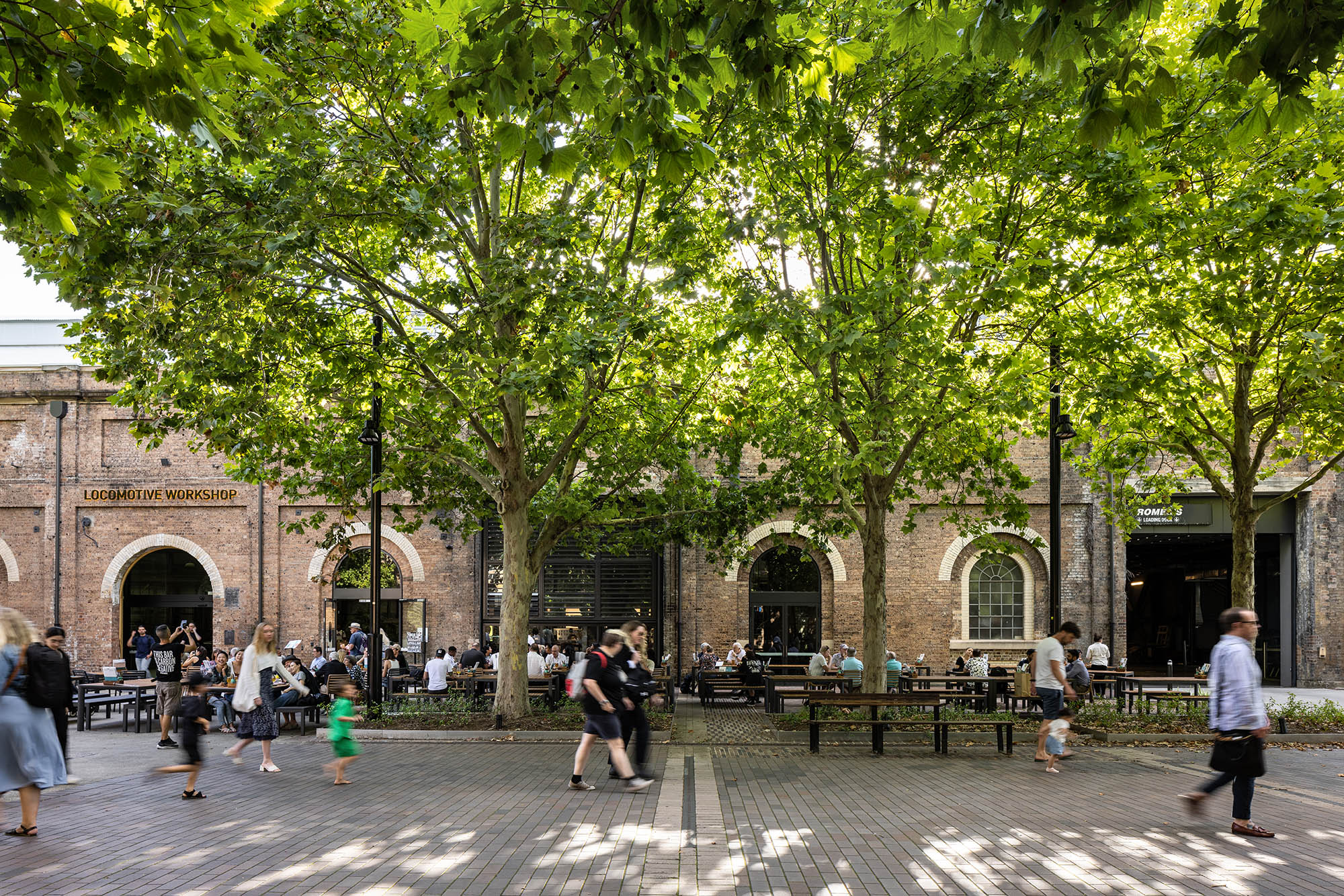
Feel-good precinct – the Locomotive Workshop (by Sissons Architects with Buchan and Mirvac Design, and Curio Projects) weaves hospitality, retail and commercial with heritage. Image: Simon Whitbread
Business Improvement Districts
In busy, complex precincts that have multiple owners and authorities, the Business Improvement District (BID) model has proven highly successful at delivering quantifiable economic benefits, says Jace Tyrrell, the inaugural chief executive of the New Sydney Waterfront Company, the first BID in Australia.
A BID is a public and private partnership model that brings government, business and the community together to improve spaces through collective investment.
“Around the world, there’s an average of about 15 percent net uplift in terms of commercial values where you have a Business Improvement District,” Tyrrell says.
He knows the model well, having been chief executive of Europe’s biggest retail and leisure destination and one of the largest BIDs in the world, London’s West End. There, 600 property owners and occupiers collectively raised $400m with the Local Council and Mayor of London to deliver a range of public realm and transport improvements.
Tyrrell says similar outcomes are possible in Australia. The New Sydney Waterfront Company is part of a $12 billion transformation of Sydney’s western harbour precinct to create the world’s best urban waterfront. He hopes it will eventually bring together 500 owners and occupiers to collectively invest. Enabling legislation, now being finalised in New South Wales, will support formal partnerships.
“Where these partnerships work well, you obviously need to have a vision for the place,” says Tyrrell.
“We have ambitions to create more stickiness of the precinct, to get visitors to stay longer and to move around the precinct more. Connectivity is a big issue for us. We’d like to operate a free electric ferry around the western harbour, underwritten by the business community.”
Tyrrell says the BID will also explore scaling environmental, social and governance (ESG) initiatives, and the coordination of cultural activations, public art, and First Nations and education programs, demonstrating the potential for the BID to amplify the city’s vibrancy and community benefits.

(Left to right) Angela Lee, Jace Tyrrell and Phil Schoutrop. Image: Alice Boshall
Social wellness opportunities
Health and well-being are central to contemporary life and there is huge potential for integrating these elements into precinct development with a focus on social wellness, says Angela Lee, managing director Asia Pacific and partner of global architecture practice, HKS.
“When we think about health, it’s not just hospitals and clinics anymore. Health refers to physical, mental and social wellness,” says Lee.
She identifies social health as an area of opportunity for owners and developers.
“People are retiring but they are picking up their grandkids and they can still play. So that’s something that we can look at in a precinct. How can we integrate sports, school and kindergarten? People continue to learn together.”
She points to large projects in the USA and Asia that combine residential, health and sporting facilities, as well as hospital precincts that include retail medical offices, hotels, spas and commercial tenancies.
The role of technology is also critical. Physical and digital spaces are merging, impacting design.
“You cannot just think of the architecture as the building. It has to be the architecture plus all the different add-on technology.”
Mirvac released a report earlier this year about the case for ‘mixed-experience’ developments.


