

Recently minted children’s book author and illustrator Emma Williams (nee Wallace) is taking visual learning to a new level with her book This Girl Built That – a reminder of the power of illustration as a storytelling and communication tool for complex, technical and under-celebrated themes and concepts.
After receiving the National Association of Women in Construction (NAWIC) Bright Ideas Grant, Williams set out to reverse a common misrepresentation of construction as dirty, gritty and joyless. In This Girl Built That, published in February, she posits an inclusive and inspiring reality for the successive generation and seeks to attract women to the construction industry.
There could be many ways for an author to realise they have ‘made it’ – receiving awards, media coverage, or appearance on a bestseller list – but Emma Williams could say she’s made it, as her devout readers have already bestowed a fandom nickname upon This Girl Built That.
“Someone on LinkedIn shared with me that his daughter won’t go to sleep until she has read “girls”, as she calls it – my book has a nickname and everything!” says Williams.
She is elated by industry figures sharing her work with their children as it demonstrates pride and respect towards an often misunderstood industry. “I felt like everyone was really proud to be sharing it – there’s little details that industry people pull out and really enjoy,” says Williams.
Aside from Bob the Builder, construction is not necessarily represented in a playful and vibrant way, so Williams is honoured to highlight the moments of joy, teamwork and camaraderie in construction in a bid to introduce children to the possibilities of the industry.

Williams is honoured to highlight the moments of joy, teamwork and camaraderie in construction.
Creating without inhibitions
As a graduate of product design engineering – a specialty that Williams likens to a fusion of mechanical engineering and industrial design – the author of This Girl Built That has maintained a lifelong knack for illustration.
She acquired a taste for construction while working for a domestic builder during her studies – working on Victorian terraces and heritage-listed houses inspired her foray into commercial construction.
“I feel really lucky because I was somewhat pulled into commercial construction,” she says. “I think I would’ve been on a different pathway had I not started doing that as work on the side.”
Williams says people constantly inquire about her creative journey. “I probably never stopped drawing. It just has changed at different points.”
Adulthood did not extinguish her willingness to approach drawing with the sense of fearlessness, wonder and delight often left behind in childhood. Kids can be rather prolific creators, Williams says, as creating and crafting often comes easily and without hesitation or self-doubt.
“When you are little, you draw without inhibitions,” she says. “You have the freedom to do it, and it doesn’t have to be good. It doesn’t have to look nice or be of a certain quality. You’re just doing it for the joy of doing it – it’s like meditation.”
Drawing as a solution and remedy
They say teaching someone else to do something can be an effective learning tool – clearly and concisely explaining a concept, methodology or process to another person can be a great way to absorb information. Williams’ steep learning curve working for a domestic builder demonstrated this theory in action and provided the initial fodder for This Girl Built That.
“When I worked for the domestic builder, I was finding that I was learning a lot while I was working, and they were always throwing me in to do client walks or inspections,” Williams remembers.
She found the only easily accessible way to articulate explanations to clients was to draw. “Drawing was always a much easier way for me to communicate what I’m trying to get across,” she says.
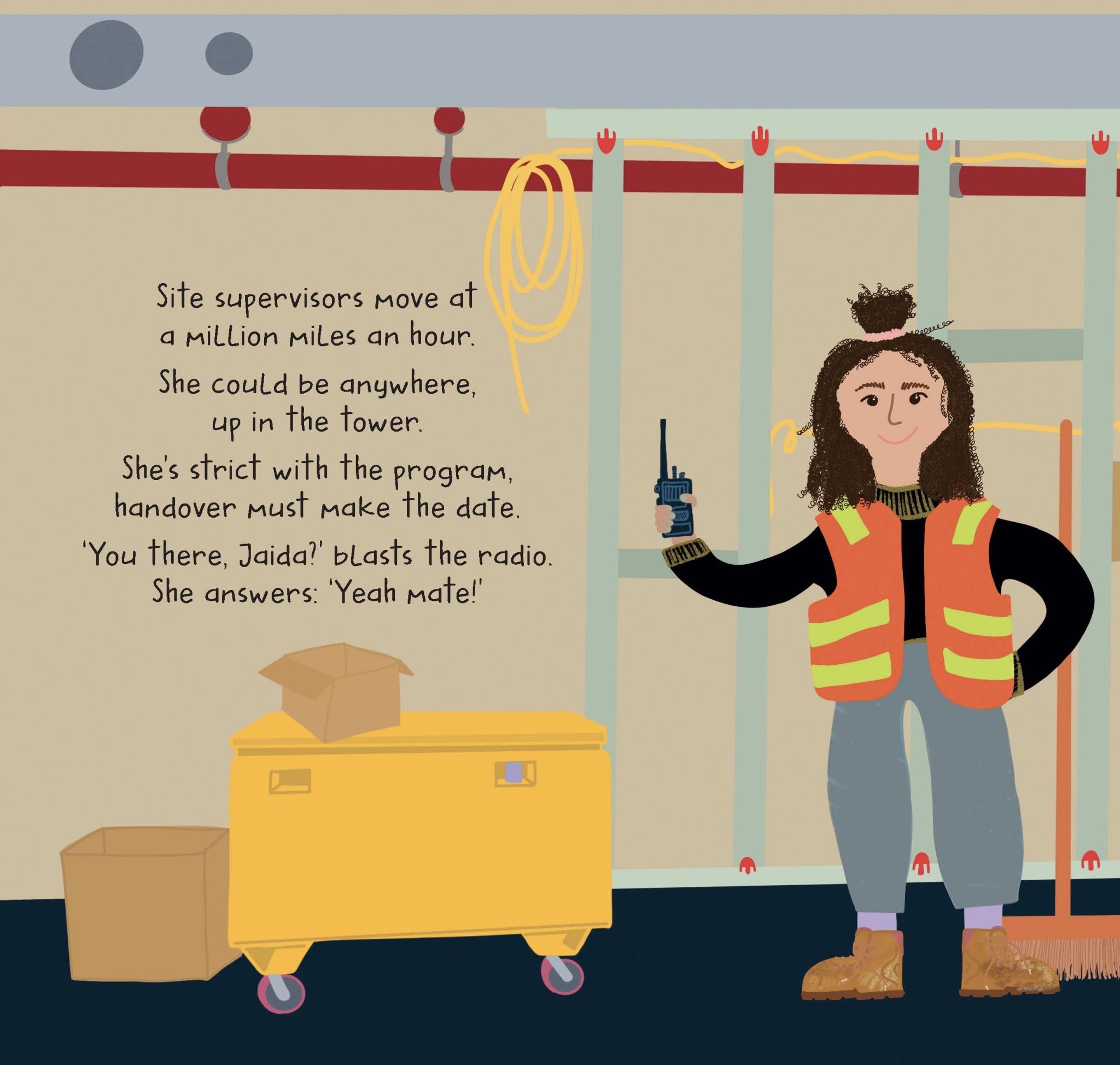
Williams believed a children’s book about construction would be an effective vessel in which to introduce children to the industry.
“I was writing down all these things that I didn’t know what they were or how they worked,” she says. “And then I’d go home and draw the things I was learning.”
A measured and self-paced learning process ensued. Williams posted her creations on Instagram and people praised her ability to make processes digestible through illustration.
“My little sketches were explaining things in a simple way and it was for me to understand, but other people were finding it helpful,” she says. Williams continues this act of service on her Instagram.
A bright idea
Women who work at Williams’ construction company are automatically signed up for NAWIC and it was a chance glance at an email for the association’s Bright Ideas Grant that inspired Willams to achieve her dream. “It had been sitting in the back of my head that I could write a kid’s book because my illustrations are very colourful, very bright, and very well suited to kids,” she says.
The Bright Ideas Grant is a $20,000 seed funding grant allocated to a business seeking to attract, retain and advance women in construction through programs and initiatives.
Williams believed a children’s book about construction would be an effective vessel in which to introduce children to construction and demystify misconceptions of the industry.
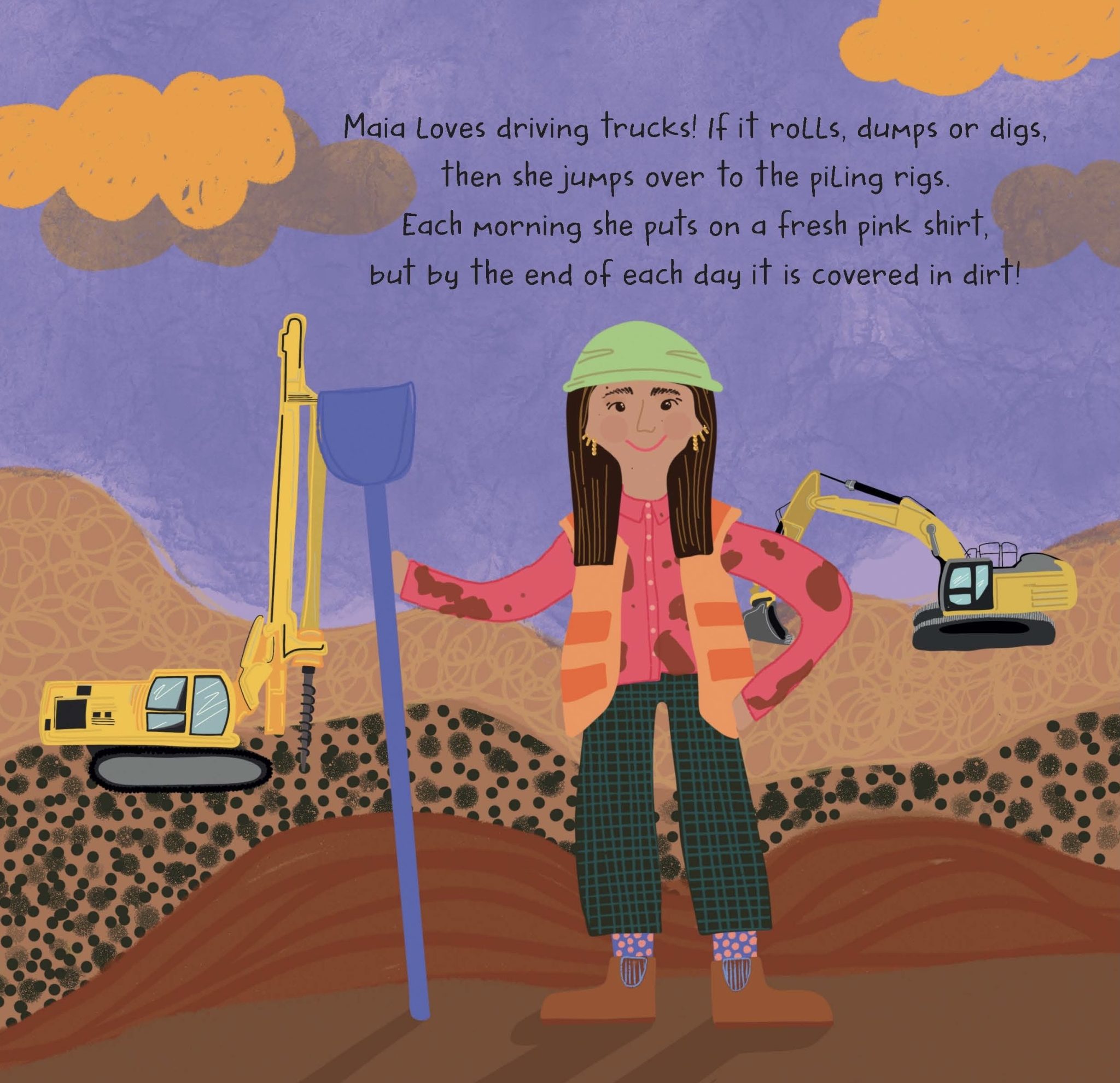
Despite an air of grit and hardness surrounding construction, Williams has shared that there are moments of fascination, fun, camaraderie and intrigue.
Completing the application for the grant further galvanised Williams into action. A business plan then followed, even though Williams confesses the initial plan was far from “refined”.
“I had to formulate this business plan and think about how I was actually going to do it,” she says.
Williams recalls being challenged but excited by the interview process, as it ignited a fire in her belly to turn her dream into reality regardless of winning the grant.
“I remember thinking, whether I get this or not, I’m going to do it because it’s a good idea,” she says. “And then I ended up getting it, and I realised I have to write a book as well!”
Williams was not necessarily struck by a stunning epiphany to be an illustrator, she simply believed it was an interesting and exciting idea. “I remember thinking this is a cool idea and it would be really beneficial,” she says. “I’m going to have a crack at it!”
Making the story resonate with audiences
The post-publication experience has been very heartwarming for Williams, as the entire creative process spanned 15 months. When she emerged from her “own little world” and encountered people appreciating her work, she was thrilled.
Williams was determined to make the story resonate with people and included industry knowledge and details.
She shares that a crane operator she previously worked with found himself reflected in the book via an idiosyncratic inclusion. “I know that he used to take his boots off when he was up in the cabin, so I drew the crane operator in their socks with their boots beside them,” says Williams. Industry figures were chuffed to see quotidian construction processes referenced in a children’s book.
Williams cites the responses from people as immensely nourishing.
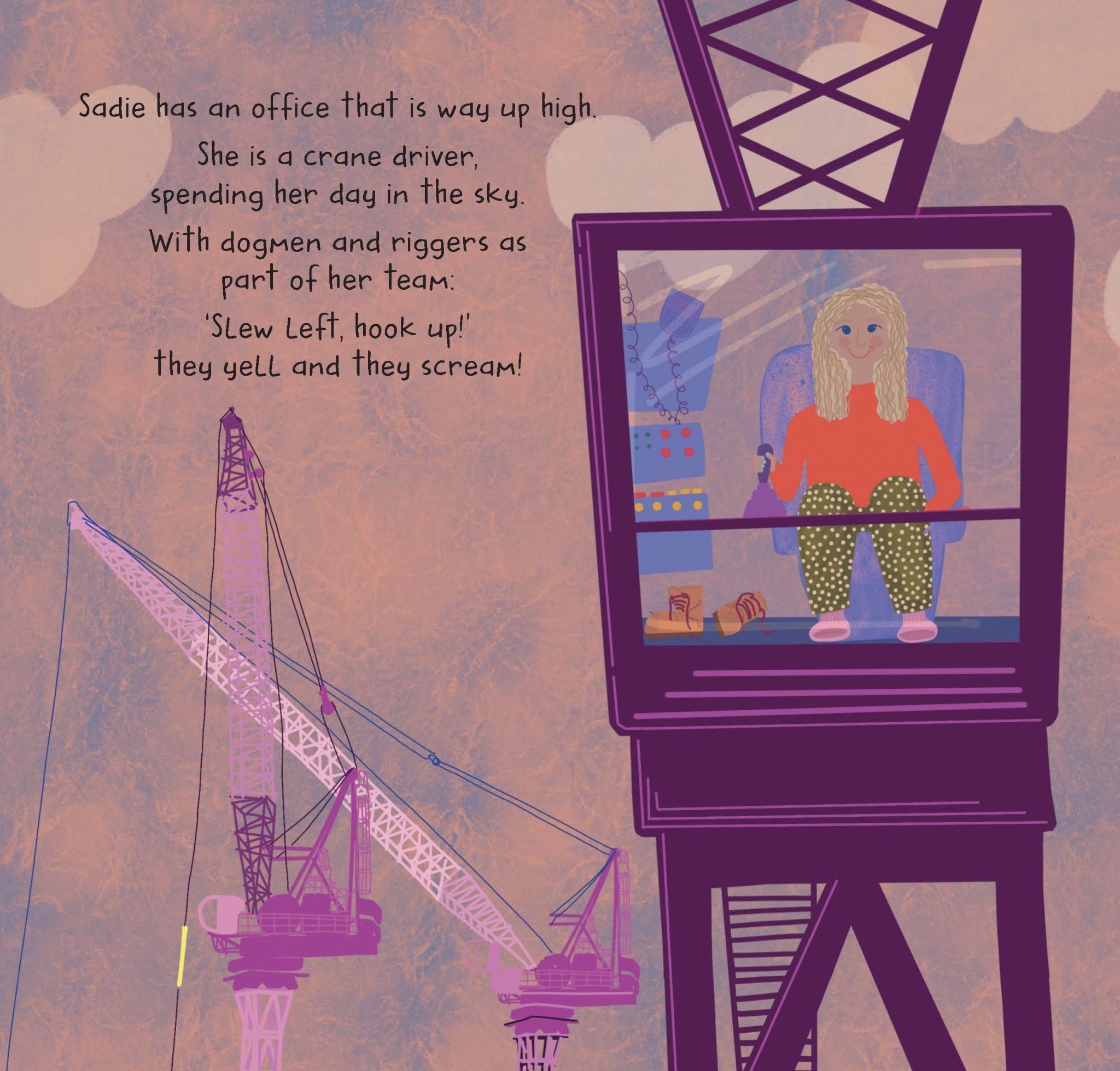
Industry figures were chuffed to see quotidian construction processes referenced in a children’s book.
“People send me photos of their kids reading the book or pointing out what character they would want to be,” she says. “One of the girls at work showed me a picture of her nieces drawing princess builders.
“My cousin sent me a photo of her daughter reading and she’s just got a page open and she’s just saying ‘together, together, together’ – it’s the cutest thing!”
Despite an air of grit and hardness surrounding construction, Williams has shared that there are moments of fascination, fun, camaraderie and intrigue.
Additionally, she aimed to debunk assumptions that construction is an exclusive boy’s club and instead showcase the numerous avenues of employment available, such as contracts administration or fire engineers – working in construction does not equate to donning a high-vis vest and hard hat while barking orders at people.
Support is instrumental
While recent feats such as the female-led and founded commercial construction company Urban Core achieving 50 percent female staff are inspiring, construction is still overwhelmingly male-dominated.
However, Williams cites a largely “positive” experience working in construction as she has been surrounded by a strong and robust support army.
“I’ve been really lucky with the people I’ve worked with,” she says. “I’ve definitely had experiences of people assuming things about me, but because there’s been people supporting me, I’ve been able to get through those things. There’s also been some men that I’ve worked with who have been huge mentors to me, and I trust them fully.”
Attraction and retention of women in construction
Williams has given ample thought towards how to improve the attraction and retention of women in construction. She has concluded that the “simple question” of how to advertise the appeal of construction subsequently produces a “complex answer”.
“There’s not that many women on site or you see them leaving,” she says. “The two big barriers for women in construction are attraction and retention. And to be honest, I don’t really know yet how to fix retention.”
She hopes This Girl Built That will play a part in addressing the issue of attraction and act as a mode of education reform. “I felt that I could make a difference with the book,” she says. “There needs to be more education about construction and trades when kids are making decisions about what they’re going to do when they finish high school.”
Williams believes students should be encouraged to nurture interests and understand that success and satisfaction are not reliant on pursuing tertiary education.
“I think encouraging people to find a job that suits them and that they’re passionate about is very important,” she says.
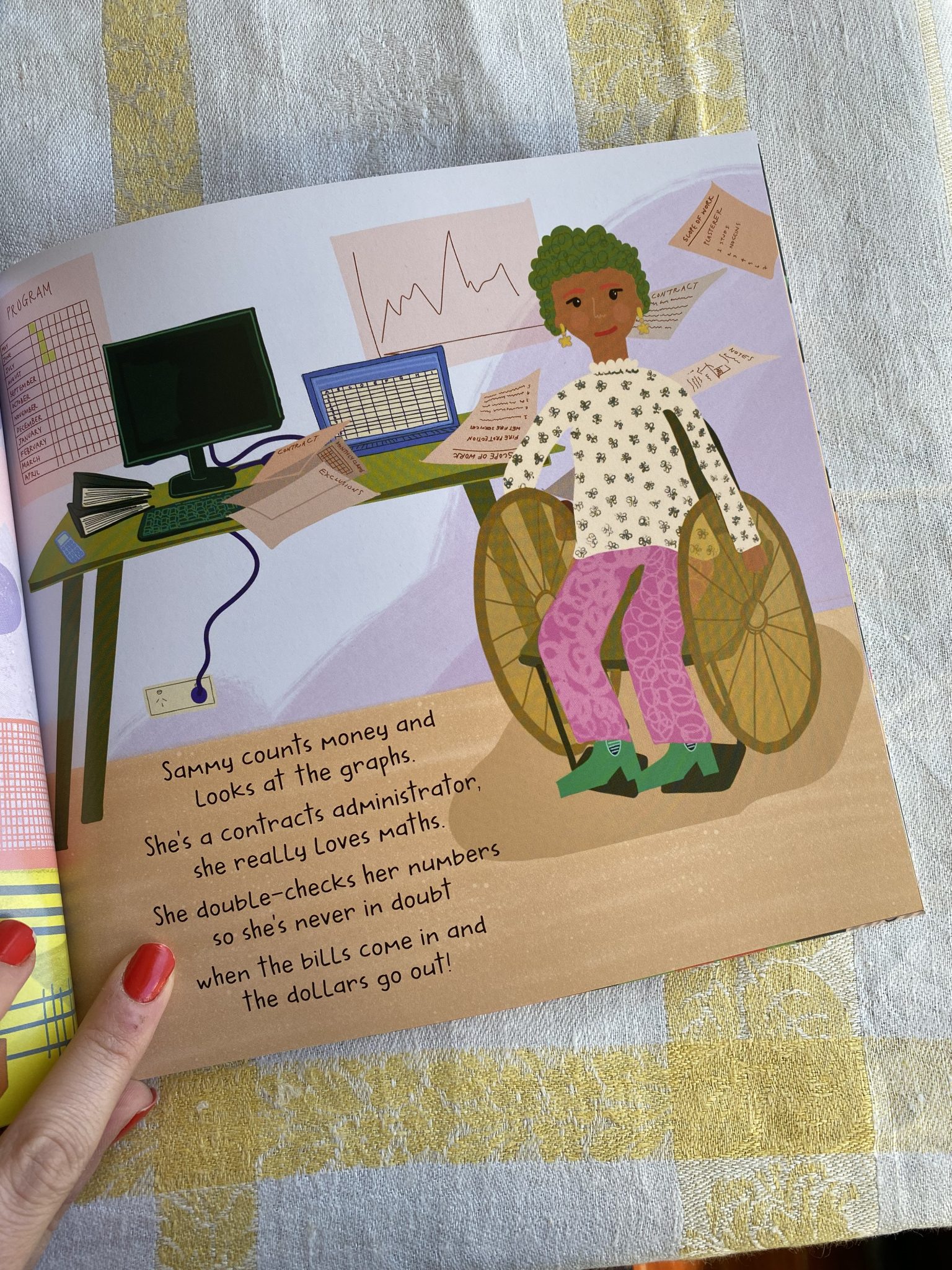
Williams says the industry demands creativity, cleverness, lateral thinking, and an aptitude for problem-solving.
Construction requires cleverness and creativity
Construction offers roles suitable to numerous demographics, abilities, sexes and ages. Williams says the industry demands creativity, cleverness, lateral thinking, and an aptitude for problem-solving.
“It’s not all just big strong men lifting heavy things,” she says. “There are jobs that are suited to a wide variety of people, but people don’t necessarily know that they exist.”
Williams is inspired by the greater visibility of women in construction and the opportunity for ascension into leadership positions and a shifting of hierarchy.
“I’m hoping that as more women are attracted to the industry, more women will stay – forming support networks will have a positive impact and they will start becoming foreman and project managers,” she says.
Is the creative horizon multi-modal for Williams? Is she branching into television or film, even merchandise? “I don’t exactly know yet,” she laughs. “I’m on a big project at the moment, and my time is very much consumed with that.”
Her inbox is inundated with requests for her next book to transcend built world boundaries and include a town planner or road engineer. “I would love to do another one. It really was such a fun process,” she says. “I hope that people feel happy with the outcome of it,” she says.
Photography and illustrations supplied by Emma Williams.
Architectural graduate and carpenter calls for change in construction.


