

Inspired by the double lattice skeleton of a deep-sea sponge in the Pacific Ocean, known as the ‘Venus’ flower basket’, RMIT University engineers have created a new material with exceptional compressive strength and stiffness that has the potential to elevate architectural and product designs.
Lead author of the RMIT University study Dr Jiaming Ma says rigorous testing into the functions of the double lattice confirmed the pattern’s ability to remain stiff and strong and contract when compressed.
Ma says the double lattice’s ability to contract when compressed is referred to as auxetic behaviour, a function that offers possibilities and opportunities in the realm of structural engineering. Auxetic materials can absorb and distribute impact energy effectively, Ma reveals.
“While most materials get thinner when stretched or fatter when squashed, such as rubber, auxetics do the opposite,” he says.
Biology-inspired auxetics achieve the impossible
Natural auxetic materials include tendons and cat skin, whereas synthetic auxetic materials are used to make heart and vascular stents that expand and contract.
However, the power of auxetic materials is often diminished by qualities of low stiffness and weak energy absorption, which is why the building material developed by RMIT University researchers is so impressive, as it provides remedies to these limitations, Ma says.
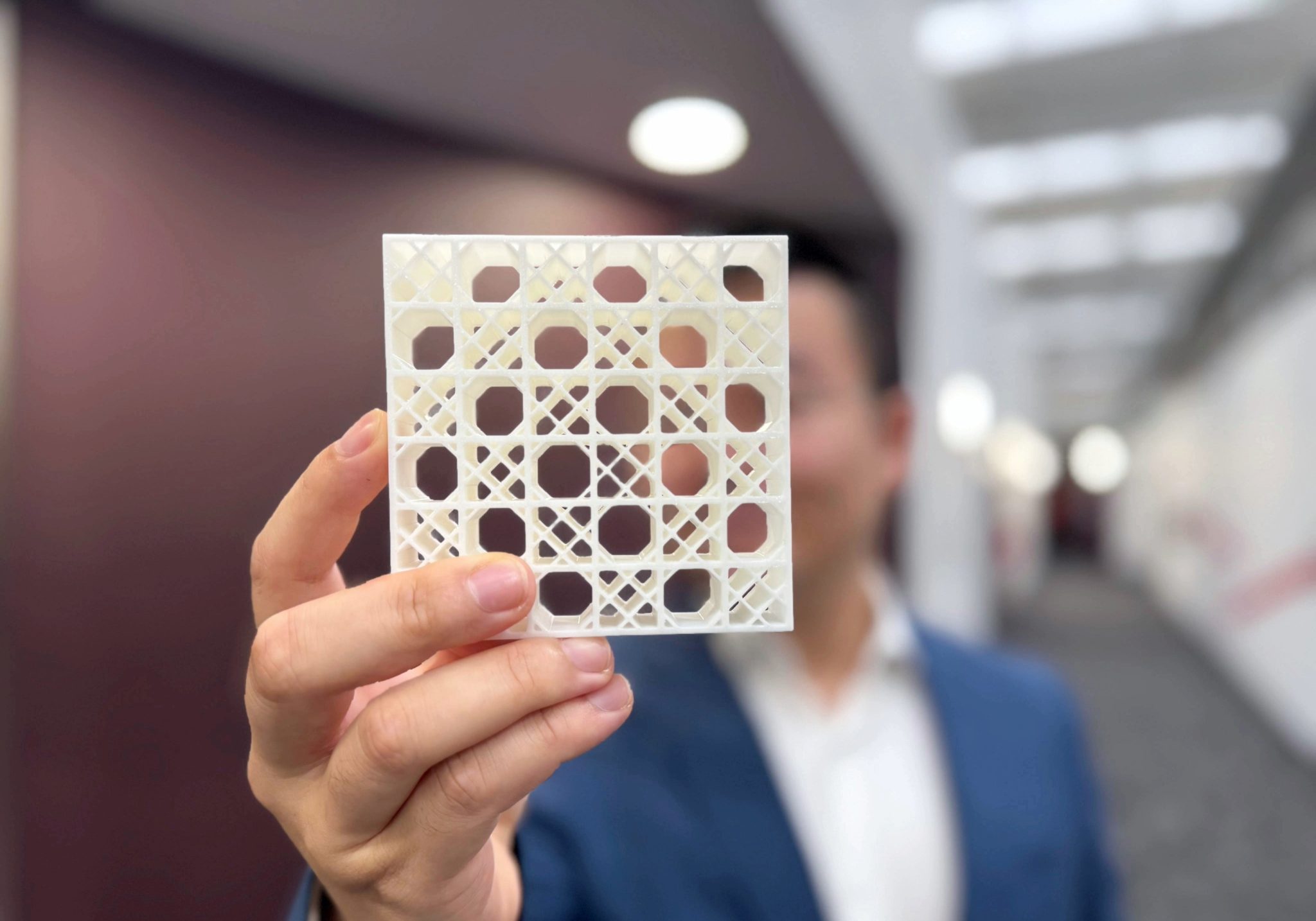
“Each lattice on its own has traditional deformation behaviour, but if you combine them as nature does in the deep-sea sponge, then it regulates itself and holds its form to outperform similar materials by quite a significant margin,” Ma says.
The team’s findings – published in Complete Structures – reveal that with the same amount of material usage, the lattice is 13 times stiffer than existing auxetic materials. Additionally, the lattice can retain 10 percent more energy while upholding its auxetic behaviour, with a 60 percent greater strain capacity compared to existing designs.
Far-reaching application of the material
Dr Ngoc San Ha predicts this discovery will spearhead a new era of sustainable building and design into action.
“This bioinspired auxetic lattice provides the most solid foundation yet for us to develop next-generation sustainable building,” he says.
“Our auxetic metamaterial with high stiffness and energy absorption could offer significant benefits across multiple sectors, from construction materials, protective equipment, sports gear or medical applications.”
Researchers say the bioinspired lattice structure could substitute a steel building frame, subsequently reducing the amount of steel and concrete required for a build.
Additionally, the structure could inform the preliminary design of lightweight sports protective equipment, bulletproof vests or medical implants.
Honorary Professor Mike Xie underscores the importance of deriving inspiration from nature.
“Biomimicry creates beautiful and smart designs that have been optimised through millions of years of evolution,” he says.
Pursuing decarbonisation and responsive solutions to natural disasters
Following computer simulations and lab testing on a 3D printed sample made from thermoplastic polyurethane, the team at RMIT’s Centre for Innovative Structures and Materials intend to create steel versions of the sea sponge-inspired design.
This design will be used alongside concrete and rammed earth structures, a construction technique using compacted natural raw materials.
Ma says the team’s priority is to discover applications in the building and construction sector, particularly when designing for natural disaster resilience. He says the lattice’s auxetic and energy-absorbing features may assist in reducing the impact of vibrations during earthquakes.
“We’re developing a more sustainable building material by using our design’s unique combination of outstanding auxeticity, stiffness, and energy absorption to reduce steel and cement usage in construction.”
Future research involves pairing the design with machine learning algorithms to create programmable materials.
Photography supplied.
Civil engineering tool hopes to fortify buildings against natural disaster damage.


