

This week, Facility Management speaks with titan in parking solutions, Angelique Mentis, on how technology and software allow facilities managers to lean into the often overlooked people-centric nature of their role, the rewards of dual-use parking and how data can act as a crystal ball to uncover the future needs of cities.
With more than a decade’s experience in parking solutions, Parking Australia’s director and immediate past president Angelique Mentis knows a thing or two about parking – most importantly, how it can be better.
“Unfortunately, people take parking for granted and they want it for free,” she says.
Mentis leads two parking solution companies – That’s My Spot and the newly launched Parking Spotz – that seek to elevate the customer experience by removing the stress and anxiety from parking and increasing user experience and efficiency.
That’s My Spot specialises in an array of traditional and innovative parking bollards including remote-controlled, smartphone-operated, manual-folding and fixed options.
The company has been endorsed by numerous high-profile clients such as Goodman Property, Westmead Hospital, QT Hotels, Meriton, Canberra Airport, Campbelltown Hospital, JLL, Accor, Cushman and Wakefield, and many more.
Despite parking being something nearly every second person has experience in, Mentis often encounters a lack of understanding about ownership and utilisation of parking across different vertical niches, and protecting individual parking bays from misuse.
For Mentis, the genesis of That’s My Spot came from a desire to dismantle such misunderstandings, starting with tightening the security of parking spaces by enabling ownership. She relies on an analogy of home security prohibiting an intruder from ransacking a fridge to illustrate the need for parking security and ownership.

For Mentis, the genesis of That’s My Spot came from a desire to dismantle misunderstandings, starting with tightening the security of parking spaces by enabling ownership
“Somebody’s not going to come into your kitchen and just empty your fridge out and you’ll let them, right?” she asks.
“Giving people the ability to physically reserve, secure and protect their parking space is where That’s My Spot came from.”
Mentis also experienced the frustrations of people trespassing in her parking spot and used this as ammunition to overcome the challenges of parking in residential and commercial buildings.
“A common scenario would be that you own an apartment which comes with one parking space, but there might be two drivers in that unit with two cars. Where will they park their second car?”
“People take it upon themselves to park in someone else’s parking spot, which is your property, or so very often in visitors parking, which causes tension in a building” she says. “And so That’s My Spot was established to solve the problem of protecting individual asset parking at a granular per bay level.”
A pest for facility managers
Mentis has collaborated with facilities and building managers, researching and gathering data to determine the extent of people violating parking space ownership. She says facilities managers cite chasing tenants who are illegally parking as commonplace and onerous.
“I’ve spent a lot of time with building and facilities managers, and in residential, they indicated they would spend at least 15 percent of their time chasing people who aren’t authorised to park in visitor bays,” Mentis says.
She says people ignoring ownership rules leads to a harmful ripple effect and visitors with mission-critical jobs are then unable to find a parking spot. “Whether you’ve got a carer coming to look after a disabled person, or a tradesman or genuine visitor to that space – and they can’t find parking, their ability to perform their task is then blocked.”
Mentis says the common misconception that residents can park in visitor bays causes angst and tension in the facility.
“Visitor parking bays are typically mandated by the building’s Development Appliacation (DA), so when buildings are built, they have a requirement for a certain number of visitor parking bays,” she says.
“And so when residents park in visitor parking, it’s a breach of the DA and it’s usually a breach of the building’s bylaws. People get upset and it’s not a very pleasant environment, especially when you live there.”
Diversifying the purpose of a parking space
Mentis hints at the success of the mixed-use Goodman Group precinct Rosebery Engine Yards incorporating That’s My Spot’s parking bollards solution as it exemplifies the power of dual use in parking.
“At this site, there are dedicated tenants during business hours, and then at night time, it becomes an entertainment and restaurant precinct,” she says. “They wanted to allow all of the dedicated parking bays to be available exclusively for their commercial tenants during the day, and then after business hours, those parking spaces can be available for patrons when the tenants weren’t there.”
Parking at Rosebery Engine Yards services two types of users, Mentis explains.

Mentis hints at the success of the Rosebery Engine Yards incorporating That’s My Spot’s parking bollards solution as it exemplifies the power of dual use in parking.
“During business hours, specific individual bays are dedicated to particular commercial tenants. This is done by the use of That’s My Spot automated parking bollards. After hours these parking bays are opened to the public so that anyone who visits the precinct for the restaurants or entertainment, can park in any bay.”
Different buildings engage with parking bylaws as they wish, Mentis says, as she has observed facilities making it work for tenants and management and choosing different possibilities and opportunities for parking.
“Some buildings penalise people for overstays and other buildings want to rent out their excess parking to generate some income and reduce the overheads for the building or even open up their EV charging bays to people outside of the building who might live in the neighbourhood.”
Parking reserved with the click of a button
Mentis says she was inspired to create an automated parking reservation solution for facility managers that allows visitors to pre-book spots on an app that would also test the validity of visitor claims.
“We had quite a bit of demand to build something that was completely automated, where a visitor could book a parking spot or a resident could invite a visitor to book a parking spot, and that visitor could be crosschecked against the resident’s phone numbers or access,” she says.
She was also eager for the automated parking reservation to allow facility managers time to focus on more thoughtful and pressing tasks, which served as inspiration for her second parking business, Parking Spotz.
“It takes a lot of the stress and frustration off the facilities or building managers’ plate and establishes a system of rules,” Mentis says.
Residents and visitors can freely and safely park with the assurance that they have responsibly gained access to a parking spot.
“For example if the building has specific rules around how long that visitor can park for, whether it’s four hours, six hours or 24 hours, we could implement those automatically,” Mentis says.
Building community within the facility
Post-COVID, Mentis has observed a paradigm shift in the parking industry, manifesting in a desire amongst building and facilities managers to make their roles more customer-focused.
“It’s about the customer experience,” she says.
“It’s no longer about the supplier saying, ‘This is the product I’ve got and this is what you’re going to buy,’ it’s now about building a seamless end-user experience in their building and its community.”
“In so many of the building management platforms I have seen, there’s now much more community focus around connecting with the residents and tenants in the building.”
Mentis speaks of how software can enrich the user experience in a shopping centre.
A shopper being able to reserve a guaranteed car spot allows for a more calm user experience. Additionally, giving the shopper more time in the centre has the ability to boost the centre’s return on investment (ROI), as they spend more time in the centre – benefiting the shopper, the facility and the facility manager.
“Rather than circling around in the basement of a centre trying to find parking for 20 minutes, the customer comes into the centre calm, as they have extra time to spend in the centre, and likely, shop more which means the ROI of the centre goes up,” she says.
Mentis says enhanced parking experience through solutions like Parking Spotz, increases a facility’s appeal and desirability, as people will opt for a facility that prioritises better customer experience.
“The user experience is what differentiates one building from the next,” she says.
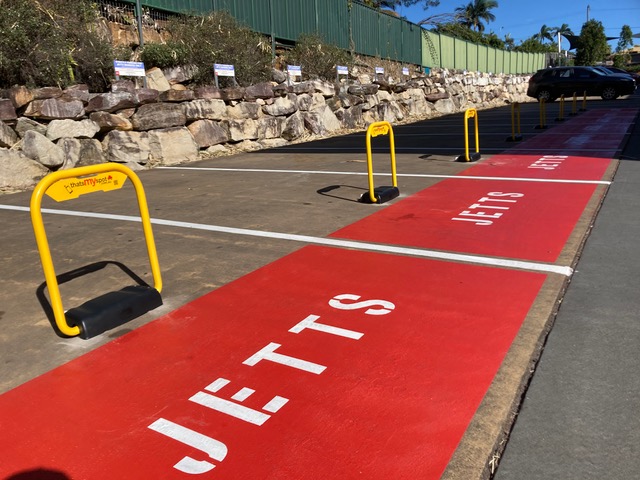
Jetts Gym in Sunnybank Hills, Queensland, uses That’s My Spot’s bollards.
Embracing building cycle times
Despite such relationships offering exposure to new ways of working and knowledge systems, Mentis notes that the dynamics of the parking industry – including approvals from strata committees in residential buildings – can prolong decision-making cycle times.
“If you’re prepared to invest the time building a relationship with that committee, that is a major plus, and I think that that’s what we do really well,” she says. “We invest the time in the industry and the sector and understand the pain point, the people and the lead time of decision making”
Mentis also laments how political cycles can derail policy advancement.
“Political cycles impact so much on policy. From an industry perspective, as a director of Parking Australia, you think you’ve got a policy and you’ve just met the new government, and developed and built those relationships, and then all of a sudden, three years later, they’ve changed.”
Mighty multi-purpose facilities
Mentis says as buildings grow in strength and use, it is important to invest in automated, integrated and remote-controlled solutions that can serve as facilities managers outside of business hours.
“As these buildings get larger, they’re hubs and small cities, so they need to have services for people to be able to drop off, pick up or use things out of hours when there’s not a building manager there,” she says.
“And the more you can automate those services and integrate and automate solutions into the building to make living or working there seamless and stress-free, with excellent facilities, then the more people are going to come and live happily in that building or in that environment.”
In embracing smart technologies and switching assets to be EV compatible, Mentis says it is imperative for facility managers to ensure leaps forward are grounded in a respect for sustainability.
“You want whatever solution you select to be future-proofed and resilient, and I think one of the ways to do that is to have technology that is not tied to one platform, so that is integrable and agnostic,” she says.
“Because otherwise buildings are locked into one only type of technology, which may not serve them in five years’ time.”
She underlines the importance of networking and seeking different opinions as a facility manager. “It’s really important in these sorts of scenarios that facility managers have spoken to other people,” Mentis says. “These are big investments for these assets, and I think that they need to do their homework around that.”
The importance of local resources in facility management adjacent industries
Mentis says her newly founded company, Parking Spotz – ‘Parking Reimagined’ – is a data-driven parking solution that capitalises on That’s My Spot’s momentum, and seeks to eventually fuse with a facility’s existing building management system (BMS).
“We’re deploying Parking Spotz in a number of residential buildings and some commercial sites,” she says. “The aim is to integrate into BMS platforms, so it could all be directly through an existing building portal, particularly in larger buildings.”
This year, Mentis confirms she is eager to grow her team, and vows to maintain an Australian-made product. “We’ve developed all our technology here in Australia and built this from the ground up,” she says.
“We’ve been very lucky with the team we’ve got, but we want to grow that more and with local resources.”
She attributes quality of product and reputability as the reason for her company’s longevity. That’s My Spot has avoided scrambling to the finish line and instead relies on product quality, reputation and has employed calmness and patience, and invested in data analysis and market research.
“This is why That’s My Spot has been in business for 16 years – our reputation and quality of product.”
The occasional polarising nature of urban parking policy
Mentis says facilities managers in urban areas are often at the mercy of the fickle differentiation between on-street and off-street parking and towing laws. “We have a lot of challenges between on-street and off-street parking,” she says.
“When you get a Development Application (DA) now, there’s a requirement usually of a minimum number of parking bays. That dynamic is changing a little bit, but it requires review from the Local Environment Plan (LEP).”
Mentis says developers are also hostile to the maximum number of parking bays under a DA. “Developers don’t like that because more parking spaces mean fewer apartments they can build.”
She speaks of the complicated nature of infringement notices for unauthorised parking on private property. With government arguing that these penalties are unenforceable, and towing laws in New South Wales becoming far more restricted, facilities managers come up against limits to their power. Software and hardware solutions such as Parking Spotz, which offers increased visibility and accessibility for facilities managers and tenants, can remedy these obstacles.
“This is where our solution comes in – having visibility over how that parking space is used all the time and being able to turn it over and share it more,” Mentis says. “It gives clear visibility in real-time to be able to see who’s using it.”
Data offers a crystal ball to the future needs of cities
Mentis also underscores how significant change in facility management can not occur until accurate data concerning transportation habits, office occupancy rates, water usage and HVAC use is obtained from sensors.
She predicts data and trend forecasting influencing policy-making and smart city development.
“I believe data can be used to inform policy decisions over time. Are the next generation still buying cars? Are they sharing cars?” Mentis considers.
She says following the United Nation’s estimation that 68 percent of the world will be living in cities by 2050, city assets need to be efficiently optimised.
“Let’s be smart about sustainability. Let’s see where our cities are going,” she concludes.
Photography supplied.
UNSW researchers advise against premature celebration of urban greenery as heat reduction tactic.


