

The Australian Grand Prix is one of the most attended races in the world and has a television audience in the tens of millions. Tim George, head of infrastructure, works to make it all look seamless.
The 2025 F1 season will go down in history as a sporting equivalent to the Thrilla in Manila boxing fest, the nearly six-hour marathon Djokovic versus Nadal match at the 2012 Australian Open or even Liverpool’s incredible comeback in the Miracle of Istanbul.
Midway through last year’s F1 season, it was thought to be all but certain for either Lando Norris and Melbourne hero Oscar Piastri to take the drivers’ championship – only before Max Verstappen fought back admirably to scupper those plans and almost clinch the title by the time the last race rolled around in Abu Dhabi.
But signs of Verstappen’s dogged ambition to snatch his fifth world driver’s championship showed at the very start of the season. It was at the Australian GP, where he missed the top spot at the podium by coming a mere 0.8 seconds behind Norris.
Melbourne’s Albert Park Grand Prix Circuit is always special – it’s typically where the first race in the season takes place and one that tens of millions of fans from around the world tune in to watch.
It’s a race where fans and rival teams catch their first glimpse of just how the cars have been set up for the year and whether the stars will align to favour some teams and drivers over the others.
The Australian GP is also one of the most visited race weekends across the annual calendar, in most cases second only to the British Grand Prix at Silverstone. Last year’s race in Melbourne drew in a total of 465,498 spectators across the four-day
weekend, the highest number in its history.
Tim George, the head of infrastructure at the Australian Grand Prix Corporation, plays a crucial role in ensuring that the venue is race-ready. One of the biggest challenges is that the Albert Park GP venue is not a racetrack for the rest of the year, unlike Suzuka or Silverstone. When not hosting the Grand Prix, it functions as a regular public park, with roads open to the public.
Challenge of temporary structures
Most of the race infrastructure needs to be built, temporarily overlaid on the existing site and then taken down post-race. “We’re putting in 54,000 temporary grandstand seats, and over 60,000 square metres of temporary structures, including hospitality structures, activations, temporary garages and general marquee structures,” says George.
“We’ll also install 47,000 square metres of temporary roadways and ground protection to protect the park, 53 kilometres of temporary fencing, and more than 25,000 individual pieces of furniture will be placed across the venue.
“Three thousand concrete barriers will be moved in and out of Albert Park, and eight overpass structures will be installed.”
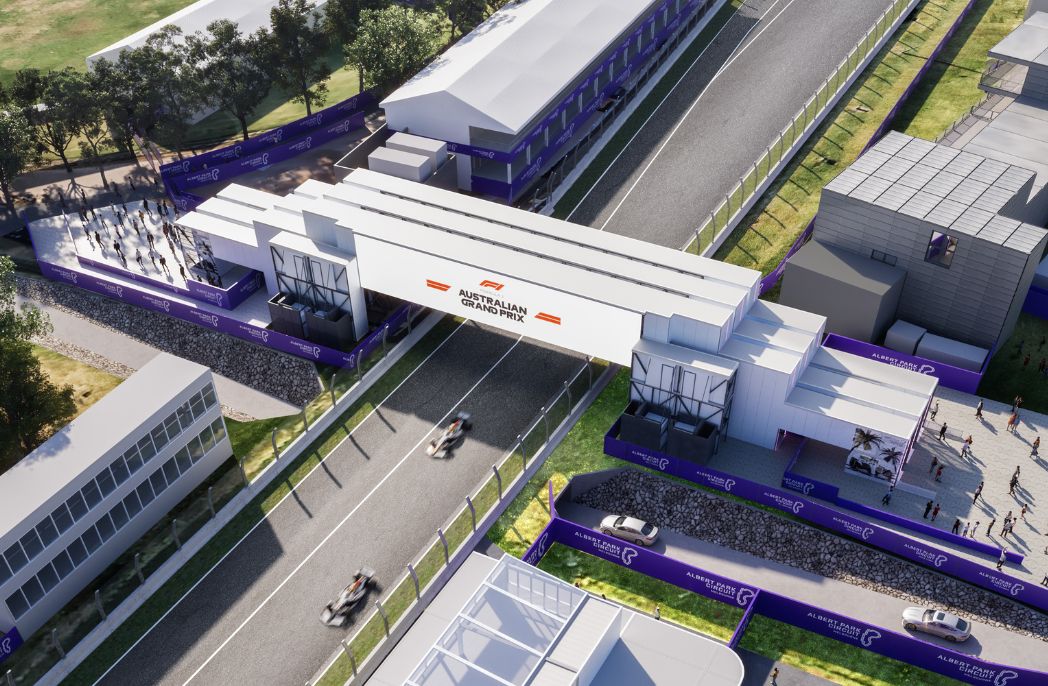
Among the many structures is the all-new six‑lane Overpass 1, a major upgrade for 2026, located near Gate 1. Constructed with 234 tonnes of structural steel manufactured locally, the overpass is the outcome of a four-month fabrication process.
Overpass 1 alone will deliver a 56 percent increase in overall sitewide overpass capacity from 2025. That increase will matter significantly considering that race day alone last year attracted more than 130,000 visitors.
Managing crowd movement and ensuring a steady flow with no chokepoints is essential for safety, and the team takes it seriously.
“We analyse crowd‑flow data from previous years – things like crowd analytics, turnstile scans, CCTV footage and even food and beverage data to understand where pinch points develop,” George explains.
“We also run extensive readiness reviews, talking through every scenario and simulating operations wherever we can. With only four days of live operation and huge crowds from day one, that pre‑event preparation is essential to ensure we have considered all aspects of the operation through the design phase.”
Apart from Overpass 1, the 2026 additions include a brand-new pontoon structure across Albert Park Lake to replace the original, which will complement the second pontoon structure added last year.
The new ANZAC Station, which opened in December, will influence how fans arrive at Albert Park, meaning the team is preparing for Gate 5 via Albert Road to see twice as much pedestrian traffic as in 2025, making it one of the most used entry and exit points at the circuit.
Access for all
The numerous pieces of temporary infrastructure, while a challenge to assemble and then take down, are also an opportunity for the team to upgrade the facilities year-on-year without the constraint of legacy facilities. The venue’s infrastructure can therefore, for example, be adapted to be more welcoming to differently-abled individuals.
The Grand Prix organisers have partnered with specialist consultants such as Get Skilled Access to ensure the infrastructure overlay offers accessibility services.
The team also launched a Disability Inclusion Action Plan last year with a baked-in commitment to designing accessible
solutions into all its new facilities. In the new Overpass 1, for example, four lifts make movement easier for attendees with
mobility challenges.
As for the permanent infrastructure, perhaps the most important is the 5.278-kilometre track itself on which the multimillion-dollar cars reach speeds of over 300kph (kilometres per hour) along the high-speed straights.
It’s where George and his team focus much of their attention. “The standards for its condition are incredibly high. It has to
serve as a public road throughout the year, then transform into a world‑class racing surface capable of handling cars travelling up to 330kph.
“A lot of time goes into maintaining the grass verges, not only so they look great on TV, but also to stay within the required height tolerances to ensure they don’t become a hazard due to the low ride height of Formula 1 cars.
“We work with Motorsport Australia and the FIA (Fédération Internationale de l’Automobile) to constantly refine and improve all elements of track safety and to ensure we maintain and achieve the Grade A licence required to run a Formula 1 event.”
Off the track, with the festivalisation of sports now becoming the norm – a brilliantly executed example being the recently concluded Australian Open – the Grand Prix team is all too aware of the need to create hospitality and entertainment offerings that appeal to the varied demographics of attendees.
“This year, we’re delivering one of our biggest hospitality programs ever. Across the venue, we’ve created 26 hospitality facilities, ranging from refreshed permanent spaces to the construction of 12 multi-level hospitality facilities,” says George.
“Alongside the wider motorsport masterclass across the whole circuit, the Fan Forum stage operates during the day, supporting fan and driver engagements, before seamlessly switching into a vibrant music and entertainment venue.”
Fresh for 2026, Clubhouse is a new elevated viewing experience, positioned on the Albert Park Golf Course overlooking
Turn 8. Race day tickets to the Clubhouse – which includes a garden lounge, DJ entertainment and private amenities, and cost $850 a pop – sold out within minutes of going on sale.
“Entertainment is a huge part of the Grand Prix, and we’re committed to making every space feel premium and innovative
each year.”
Customer first
From an infrastructure and facilities management perspective, George outlines that all decisions are ultimately customer-centric and in the service of creating an experience for attendees and viewers that is second to none.
To that end, he says there is a large help desk support service that operates on event days to centralise all issues and provide oversight, not only during the event but, importantly, through the post-event debrief process. “Using this data, along with crowd analytics, helps shape key decisions throughout the planning process.”
It allows the infrastructure team to progressively review the event offering each year and introduce upgrades where necessary the following year. In advice that could prove invaluable to those starting their career in large-scale facility management, George adds, “Understand your audience, plan meticulously and build flexibility and resilience into your infrastructure.”
This article first appeared in the March 2026 edition of FM magazine. To download the entire edition for free, click here.
Read more: Meet your local FM: Waqas Zaki, Mondelēz International


