

The recent 2025 State of Design & Make report from Autodesk highlights waning optimism around AI, alongside mounting concerns over cost control, sustainability and a snowballing skills shortage.
The 2025 State of Design & Make report surveyed and interviewed 5600 global business leaders – including 460 in Australia – in Design and Make industries such as architecture, engineering, construction and operations, product design and manufacturing, and media and entertainment.
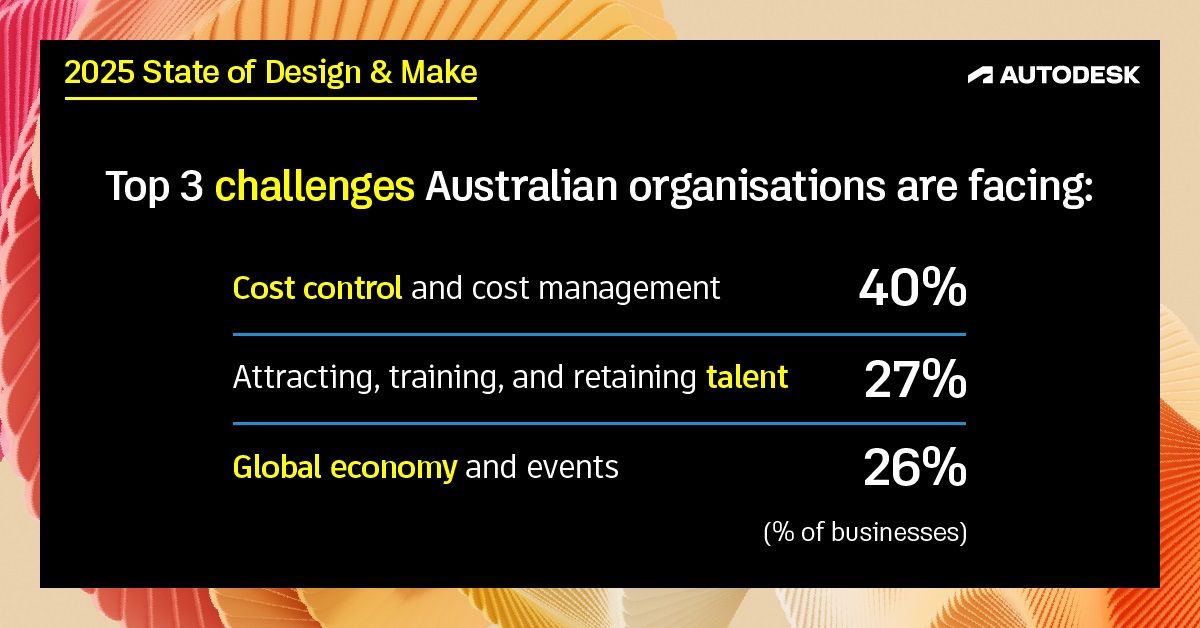
One of the most striking revelations from the report is that 40 percent of respondents cite cost control and cost management as the greatest obstacle facing their organisations.
Such industries suffered from last year’s cost of living pressures, high interest rates and inflation, which contributed to a decrease in investments. However, the report reveals industry leaders are eager to regain investment momentum, with 67 percent of respondents confirming their organisations will increase future investments.
Australian leaders are realistic about the cumbersome and risky implementation of AI
Autodesk Australia and New Zealand senior regional director Andy Cunningham says AI is succumbing to the destiny that awaits the majority of “tech hype cycles”.
“The report reveals Australian organisations are feeling less confident in AI,” he says.
Only 68 percent of respondents maintain that AI can enrich their industry, which is a statistic down nine percent from last year’s report. This decrease corresponds with global findings, which confirm a 12 percent annual decline in Design and Make leaders expressing faith in AI.
55 percent of Australian leaders fear AI will upend the tenets of design within their industries. This is notably higher than the global average of 48 percent, who remain sceptical of AI’s purported value.
Cunningham says burgeoning scepticism towards AI comes from greater knowledge about the technology.
“This global drop in AI optimism across industries signifies the technology is following the classic tech hype cycle, as leaders face the reality of implementation, an ongoing technical skills shortage, and the limitations of the current technology,” he says.
“We were surprised by the AI optimism last year, but it appears the more we are learning about the technology, the more sceptical organisations are becoming.”
Scepticism and a lack of trust towards technological innovation, such as AI, likely mirrors flaring global uncertainty and geopolitical tensions, as 72 percent of leaders believe the global landscape is more uncertain and only 62 percent acknowledge they are prepared for changes.
Supplied by Autodesk.
AI is beneficial for sustainability pursuits despite being subject of distrust
The report also discussed the levels of industry engagement with AI for sustainability benefits. While 94 percent of Australian leaders emphasised a willingness and desire to be more sustainable, only 30 percent of respondents rely on AI to achieve sustainability goals. In comparison, 39 percent of Asia-Pacific and global respondents report using AI for this purpose.
Cunningham warns of a lag in Australian industry leaders embracing AI to meet sustainability credentials as hazardous.
“This slow-moving approach to using AI for sustainable solutions may be harming our progress,” he says.
“AI has been crucial for enhancing sustainability in the design and manufacturing industries, where 80 percent of a product’s environmental impact is influenced by decisions made at the design stage.”
Business growth indebted to digital maturity
In addition to evaluating a company’s skill in incorporating AI into practices, the report measured the level of digital maturity and literacy in Australian Design and Make industries. Only 238 of Australian respondents were deemed digitally mature companies, meaning they are approaching or have accomplished digital transformation goals.
Cunningham attributes digital maturity as responsible for boosting business confidence and growth, as digitally mature companies often boast a more extensive data system and capability to gather more information.
“The results show digitisation continues to be a crucial foundation for business confidence, keeping a competitive edge and encouraging investment in research and development,” he says.
Refusal to digitally mature may worsen skills shortage
Respondents recognised combating the skills shortage as a major challenge for Design and Make industries. More than half (61 percent) of Australian business leaders admit that a lack of skilled talent limits growth and expansion.
Digital maturity is advantageous when battling the skills shortage, as 77 percent of digitally mature companies historically invest more in digital training and 74 percent of digitally mature companies will implement ongoing learning programs.


