

Titans in the smart elevator and escalator industry, KONE is refining the flow of urban life and capitalising on the present opportunity for modernisation and technological innovation.
A few months ago, Jade was working her usual Saturday night shift at a restaurant in Federation Square and was carting a box of 12 bottles of wine – with two six packs of beer and the building’s central keys perched atop – when she had a vexing encounter with an elevator.
“I stepped out of the elevator on the mezzanine floor and watched the keys slide across the box and plummet to their death, as I was holding a box of wine – I couldn’t do anything about it! I heard a very distant thud at the bottom of the elevator shaft,” she recalls.
The restaurant Jade works at is separated into four levels in ascending order – ground, mezzanine, level 1 and level 2. Jade dropped the box of wine and hurried down to the ground level, praying the keys would be waiting in the elevator on the ground floor, but they had fallen into the elevator shaft.
After she walked with her tail between her legs up to inform her manager – who reportedly cackled – about what had transpired, a slew of frustrating operational misfortunes followed, emphasising the importance of facilities partnering with reputable and efficient vertical transportation providers like KONE.
Makeshift retrieval kits save the day
Jade and her manager called Federation Square and were informed that they had to deal directly with the elevator company as it was their jurisdiction.
“As we made the call at around 11pm on a Saturday, they informed us that the earliest they could send someone would be Sunday morning, which would technically be an out-of-hours call and somewhere between $400 and $500,” she says.
The team decided to wait until Monday for a call-out to save on costs. However, early on Sunday morning, the owner of the building received word that an out-of-hours call had been ordered for Sunday – the opposite of what Jade and her manager had told the elevator operator.
The call-out was cancelled. After much confusion and miscommunication, Jade arrived early for her 4pm shift on Sunday, armed with twine, magnets, a tape measure and most importantly, steely-faced determination.
“We needed these keys – we don’t have duplicates of some of the keys, they are the only ones we have,” she says.
Crouched in the elevator, Jade measured the depth of the shaft from the mezzanine level to the ground level with a tape measure and after surmising that these shafts had likely not been cleaned in years, got to work. “I made a sort of stick with plastic liners from glass doors and taped magnets to the end of it,” she says.
Her partner was on standby at Bunnings scouting the aisles for equipment – he found a magnetic device that allows surrounding items to avoid being magnetised. However, it wasn’t necessary, as Jade got her comeuppance with the elevator and managed to get the keys with her makeshift device.
“I was so happy I almost cried!” she says. “I promptly went upstairs to my restaurant and gloated to my colleagues for the next two days.”
And while Jade’s feat is impressive, KONE CEO Philippe Delorme’s discussions with Facility Management reveal that rather than taking things into your own hands, it is better and much safer to call in the experts. Some of KONE’s many services, including the ‘one-minute rescue’, a 24/7 hotline and cloud monitoring to dispatch field technicians, would have remedied this elevator bungle, ensured staff safety and prevented damage to the elevator.
Moving on up
KONE CEO Philippe Delorme has spent 30 years in the building industry, most notably as the former executive vice president of Schneider Electric’s Europe organisations.
However, he admits ignorance of the importance surrounding the vertical transportation of people and how the humble elevator carries (no pun intended) more power, complexity and nuance in the energy-efficiency realm than commonly assumed.
“I thought energy was the most important thing that would happen in a building,” he says. “But since discovering KONE’s elevators, I now understand how critical the vertical transportation of people is.”
Delorme is honoured to be leading an innovative company and was drawn to the culture and the people of the historically family-owned KONE. “I was very impressed by the culture and by the customer commitment. I was also impressed by how many moving parts there are at this market,” he says.
Schneider and KONE share a commitment to sustainability. Delorme cites this mission to reduce corporate carbon footprint and live and work sustainably as one of the main reasons he chose to work with KONE. KONE is poised to skillfully navigate the rollout of digital technology and the race to decarbonise.

Delorme cites the mission to reduce corporate carbon footprint and live and work sustainably as one of the main reasons he chose to work with KONE.
Modernisation does not need to be apocalyptic
Elevators face an unavoidable destiny of modernisation. Delorme says this adaptation to the digital world is made even more unique due to the lifespan of elevators. “At some point, it needs to be modernised or replaced, however, elevators are within buildings for longer than 15 to 20 years,” he says.
Delorme is inspired by the need to modernise as it delivers an opportunity for progress and to incite lasting change in the decarbonisation movement. “It creates a massive opportunity for a change of business model to move from mostly new build elevators to modernised elevators,” he says.
KONE’s RISE strategy, launched in September, evolved from a desire to pounce on this opportunity, not only to decarbonise and forge a new business model, but also to ensure a smooth digital transformation and maintain strong customer engagement.
“We thought that with the current competitive context, we had a unique opportunity to lead and to rise and become the industry leader – first in employee and customer engagement, second in innovation and sustainability, and, as a result, in profitable growth, which is profit and sales growth,” Delorme says.
He explains the strategy concerns achieving four operational priorities. “The first order of business is digitising our services, secondly is to accelerate our modernisation opportunity, thirdly is to drive sustainability, drastically cutting carbon, and lastly, to support our residential strategy,” Delorme says.
A goal that threads into each operational priority is to become the easiest company to work for and with. Delorme says shareholders, customers and staff are already very receptive to RISE. “We’re very happy to rise and lead and to drive this strategy forward,” he says.
Commitment to safety is sustainable
Delorme acknowledges the vastness of sustainability and how efforts to live and work sustainably encompass more than decarbonisation and electrification. KONE’s engagement with social and cultural sustainability is exemplified by investing in staff and customers to guarantee longevity for the company.
“One angle is gender diversity, which we think we are doing good work in, but we want to do great work,” Delorme says.
Safety is also a primary component of KONE’s sustainability plan, as elevator technicians, operators or subcontractors can be exposed to dangerous circumstances. The company perceives a commitment to safety as a commitment to extending the longevity of the company and industry.
“We take safety very seriously,” says Delorme. “I’ve been very impressed by the safety culture and we want to make sure that this is at the core of our sustainability commitments.”
Possibilities and rewards of partial modernisation
KONE managing director for Australia and New Zealand Marek Oppeln-Bronikowski says people who fear that replacement will render products and services obsolete – or wince at the thought of the logistical challenges pertaining to digital transformation – can opt for partial modernisation with KONE, a carbon-neutral point of difference.
“We have about 200,000 different types of equipment in Australia, of which around 25 percent or more are 15 years old or older, meaning that we have a sizable number of units that will require some modernisation,” he says.
“You can replace the key components which will actually allow you to safely use the equipment and bring in all these connectivity elements.”
Oppeln-Bronikowski says introducing new machinery slashes carbon and simultaneously saves time. “At the same time you’re doing it for half of the time that you would normally spend when doing a full replacement,” he says.
“We really want to differentiate in the space of modernisation by bringing partial modernisation and simple offers that would be easy for our customers to understand, easy to deploy and more cost-effective,” adds Delorme.
How energy efficient can elevators really be?
Delorme says elevator design has increased in sophistication over the past few decades. “If we compare a top-notch elevator made 30 years ago and an elevator today, the elevator today would be 90 percent more energy efficient,” he says.
KONE is eagerly embracing opportunities to construct and maintain more energy-efficient elevators, specifically by manufacturing elevators from less materials and reducing their weight. “The next generation elevator we’re going to launch will be 20 percent lighter, and with 20 percent lighter, you will have less mass to move and you use less energy,” says Delorme.
Additionally, Delorme says the rewards of the hybrid model are not just confined to the automobile industry, but will also be harnessed in elevator operation. “We call them regenerative drive models – [they control] the part of the motor that stores energy when the elevator goes down, so that when it goes up, the energy has been stored and harvested.”
Delorme says selecting the composition of an elevator’s rope is also a way to exercise sustainability in elevator operation and maintenance. “The transmission of the loads between the motor and the rope is extremely efficient.”
“For high-rise buildings, we have ropes that are made of carbon, which are actually seven percent more energy efficient. Carbon ropes last two to three two times longer – a steel rope would last five to seven years, our carbon base ropes would last up to 15 years,” says Delorme.
Remote assistance and support
Oppeln-Bronikowski says KONE’s commitment to environmental responsibility is also evident in the company reimagining ways of service by reducing site visits. KONE proposes something new – an elevator that can be monitored from 200 different touchpoints.
“This data goes up to the cloud and is being understood by the system and sent back to our technicians, who, instead of going to the location of the elevator, can remotely act on the needs of the unit and prevent a stoppage of the unit,” he says.
Delorme says the industry was once slightly monolithic and resistant to change, however, he is inspired by partial modernisation and the popularity of standardised solutions such as remote assistance.
“If anyone is blocked in an elevator, we can remote service those elevators in seconds rather than minutes or hours,” he says.
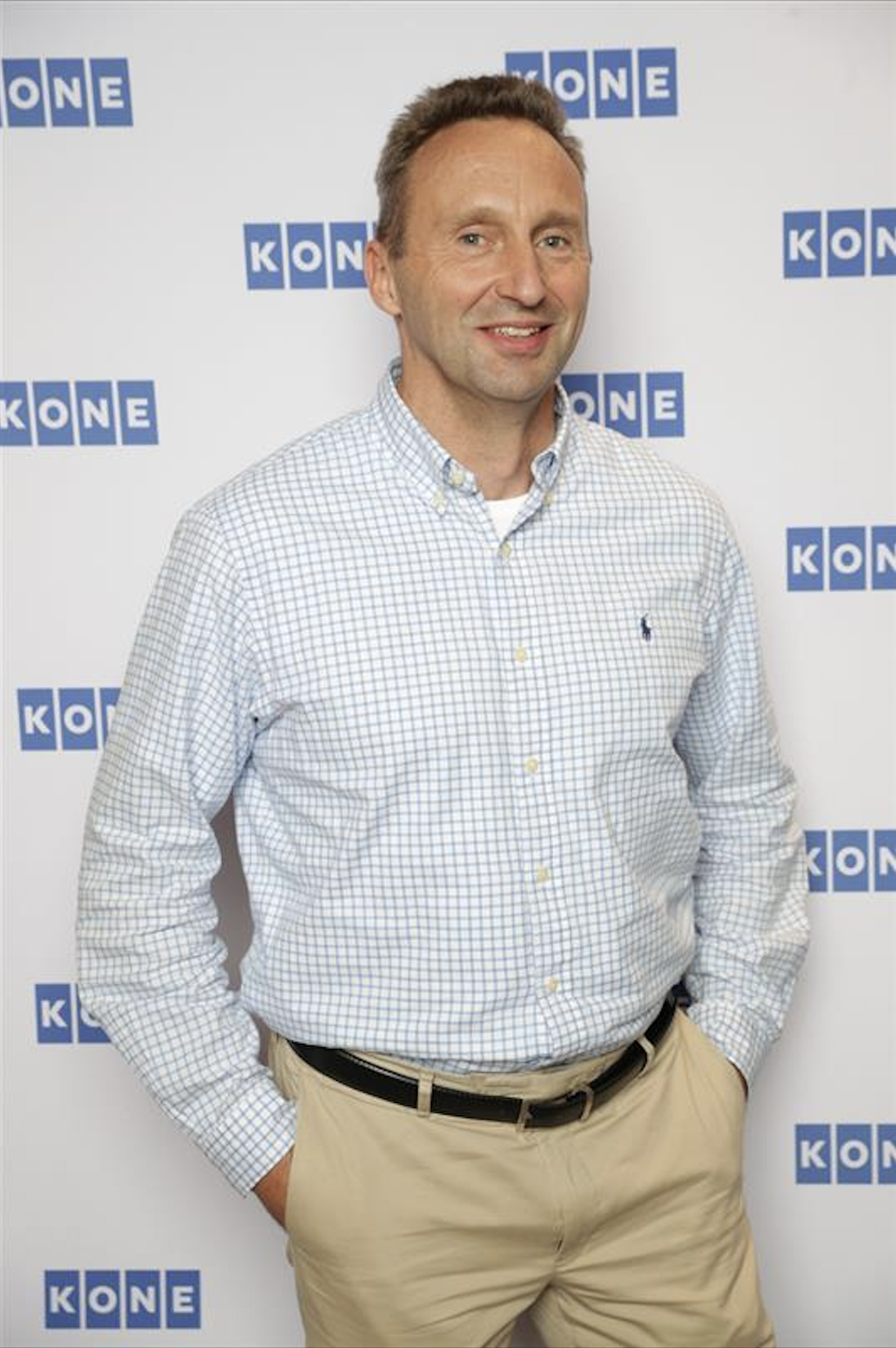
Oppeln-Bronikowski says KONE’s commitment to environmental responsibility is also evident in the company reimagining ways of service by reducing site visits.
Delorme cites change management as the main challenge to executing energy-efficient solutions – technology is not the challenge; the challenge is overcoming unwillingness to change. RISE responds to this challenge.
“We believe that for KONE to lead and to rise, we have to evolve our culture to be more bold, to be more daring, to be more hungry for change, which is true for KONE as a company, but it’s also true for the industry,” says Delorme.
Oppeln-Bronikowski prescribes trust and respect to this adaptation. “It’s about us educating them and them trusting us that we are advocating on their behalf,” he says. “It’s a true partnership.”
Digitisation a blessing and a curse
Although acknowledging that seamless and successful digitisation is a challenge, Delorme is enthralled by the rapid pace of digital adoption, the shift to electrification and decarbonisation and the willingness to devise new ways to work and live that safeguard an environmentally friendly future.
“We believe we have a role to play in this industry to accelerate the change and accelerate the shifts,” he says.
Oppeln-Bronikowski says many companies approach KONE and enquire about how to upgrade equipment in line with energy savings and optimum comfort for end users. “They like the innovations, they want to show a different card for the end users. They want to show digital ways of working,” he says.
Both Oppeln-Bronikowski and Delorme maintain interbody collaboration as essential for the realisation of digitisation to avoid siloing different specialties and disciplines.
A blessing of the acceleration of digital adoption is KONE’s renowned ‘one-minute rescue’ service, which relies on cloud monitoring to instigate self-operated escape.
“With this new offering that we have, you can actually exit the elevator within one minute by having the elevator connected to a 24/7 live operator who will calm you down and ask you if you’re willing to execute the process for self-escape out of the elevator,” says Oppeln-Bronikowski.
The responsibility for escape is entrusted to the person or persons trapped, which Delorme says is an appealing point of difference for facilities managers to latch onto.
“By having efficient cloud monitoring and controlling our people flow solution, we can dispatch field technicians much more efficiently and on the go,” says Delorme.

Delorme cites change management as the main challenge to executing energy-efficient solutions – technology is not the challenge; the challenge is overcoming unwillingness to change.
Education will drive modernisation
KONE hosts numerous educational programs, including internships, partnerships with educational institutions and an International Trainee Program for students interested in a career at KONE.
Oppeln-Bronikowski says safety is the primary message in such programs. “In Australia, up to 20,000 hours of training has been delivered to our staff, especially to ensure our operative and field technicians on the ground have the proper training to protect their lives,” he says.
KONE also delivers events at shopping malls to educate children on how to safely use escalators and also ensure security cameras are strategically placed for peak monitoring and surveillance in the event of an emergency.
“We also coach our sales teams on our latest sustainable technology so they can help guide customers on how to select the right product to be more environmentally friendly,” says Oppeln-Bronikowski.
Delorme and Oppeln-Bronikowski maintain that sustainability has hit the elevator and escalator industry in an exciting and innovative way, and digitising the industry will undeniably provide better service to customers.
“We are determined to really drive our industry forward to rise. We believe there are few battles that are worth fighting,” says Delorme.
Photography supplied.


