

When attending a concert at a theatre, moseying around an art gallery or museum, strolling past your local PCYC or experiencing child-like wonder at the zoo, have you ever stopped to ponder who is in charge of the management and operations of this bustling and beloved facility?
This year, Facility Management launches a new editorial series called ‘Meet Your Local FM’, where we talk with the facility and operation managers, technical service and safety operators, and sustainability officers of iconic Australian institutions.
We’re diving deep to reveal a facility’s inner mechanics, along with the who and how of what it takes to keep these special spaces running so smoothly. We’re putting a face to a facility and debunking any assumptions surrounding this essential profession which many don’t know a lot about.
If Sea World and Sea World resort facility manager Brett Stevenson had a dollar for every time someone assumed that gleefully swimming with dolphins was a core fixture in his day, he could finance endless rides on the park’s renowned wooden roller coaster The Leviathan.
However, he wouldn’t need to, as his role guarantees entry to all park rides – a status that bestows enviable clout upon him during the school holiday periods.
“I’m definitely very popular,” he laughs. “My nieces and nephews are forever getting tickets.”
Stevenson cherishes such moments when he can share the wonder of his work with loved ones, as it prompts him to pause, linger and appreciate the magic of the park.
“You do occasionally have to stop and enjoy those moments – I get to look at the animals from a different set of eyes,” he says.
A beloved tourist attraction since the 1970s
Gold Coast local and titan in the tourism industry Keith WIlliams opened Sea World as a water ski show in the late 1950s and eventually transformed the site into a marine life and amusement park in 1971.
It has remained a significant part of the Gold Coast’s cultural and social tapestry even after undergoing numerous redevelopments, including the opening of new rides and involvement in marine life rescues.
The success of Sea World kickstarted the Gold Coast’s era of theme parks, with Movie World opening in 1991 and Wet’n’Wild following suit in 1994.
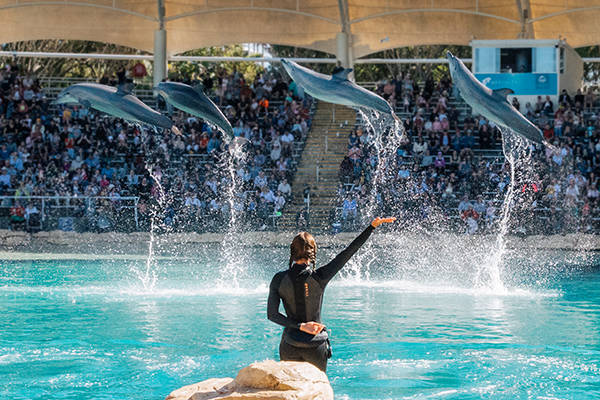
The affinity dolphin presentation is a treasured Sea World show.
Award-winning carpentry background
More than 20 years ago, Stevenson spotted an advertisement in a newspaper for a carpentry apprentice at Sea World and jumped at the opportunity. His industry start also saw him work at Movie World and Wet‘n’Wild. In 2005, Stevenson’s head of human resources Ann Maree O’Neill encouraged him to apply for the ‘Apprentice of the Year’, award, which he promptly won. This motivated him to also receive his builder’s licence.
He became a supervisor at Sea World in 2009, and the opportunity soon arose for him to act as the maintenance supervisor of the Sea World resort. As a supervisor, he oversaw approximately two dozen room refurbishments.
Stevenson found his carpentry background to be valuable and advantageous when keeping the cogs turning at the park and resort – when he started, he was the only member of staff with a building qualification.
“In fact, even now, I think I’m about one of two people in the whole company with a builder’s licence,” he says. “We do so many renovations and daily repairs, so it’s very handy to have a good trade background.”
Good challenges
Five years ago, he was offered the role of facility manager across Sea World and Sea World resorts.
Although the COVID-19 pandemic quickly followed Stevenson’s move into facility management, he labels navigating COVID as a “good challenge”. He relished absorbing the operations and machinations of a hotel, and the majority of the people he comes into contact with are electrical or mechanical engineers, which allows for exciting cross-disciplinary collaboration and cooperation.
Stevenson is keen to eventually take on facility management for the whole group, however, he is content in his current role, mainly due to familial obligations.
“I’m probably not quite ready to take on facility management across the whole group. I’ve got two little kids that take up a lot of my time too!” he says.
Not enough hours in the day as a facility manager
The well-known narrative of an average day in facilities management being a fallacy is what Stevenson loves the most about his job.
“It’s one of the beauties of the job,” he says. “No two days are alike. One day I’m dealing with recovering a roof on a polar bear habitat, and then the next day I’m looking at renovating 120 rooms.”
Stevenson’s days are flooded by morning musters with the team at the resort and park, daily meetings with the general manager, housekeeping and attending to ongoing projects, emails, purchasing, payments and invoices.
It is a rare sight to see him stop and enjoy a coffee, however, he welcomes the constant flurry of activity, even though he unsurprisingly admits that there are not enough hours in a day.
Sea World and the resort are unique in the fact that damage is often discovered in the morning, and the prime suspects are the group’s target audience – kids. Despite bringing a sense of fun, life and vibrancy to the park, the youngest ticket holders are notoriously accident-prone and plough through garden beds and scribble over resort walls – giving the resident painters a good workout.
“We have a full team of painters here, but I honestly think even if I had 20 painters I still wouldn’t be able to keep up,” says Stevenson.

The New Atlantis precinct features three attractions – Leviathan, Trident and Vortex.
Delivering quality on a budget
Stevenson believes more people are coming to terms with the purpose of facilities management as opposed to dismissing it as merely administrative work. He is proud of how his team carries a sense of reverence and responsibility.
“We are basically in charge of every renovation that ever happens,” says Stevenson. The team juggles conducting renovation work alongside remaining on top of technological updates.
He cites a major challenge is delivering a flawlessly and pristinely presented park on a budget – it is a test of endurance that involves judiciously allocating funds and ordering priorities.
“People come here and expect a level of quality, but at the same time, you’ve got to manage your spend and your trades and how you run it,” says Stevenson.
At the end of the day, facilities management is a department that doesn’t make money, but requests it. Stevenson reports an advantage of having financial literacy coursing through his veins as his parents were accountants, yet he still feels pressure due to the purely expenses-based nature of facilities management.
“You’ve got to justify and explain every dollar that you ask for,” he says.
He hints at the occasional instability of the facilities management world – subject to change and operational overhaul at any time.
“We can lose air conditioners and whole generators at the drop of a hat because of a mechanical issue, and that’s a big expense these days to replace,” says Stevenson.
Sophisticated operations and technology
Stevenson says the park and resort’s relationship with technology continues to increase in sophistication, particularly exemplified by remote-controlled technology.
“I think every day we’re probably developing a little bit more on what we do,” he admits.
The resort relies on an autonomous and remote-controlled system that eliminates the need for time-consuming daily check-ins and instead allows the team to focus on tasks of higher priority and urgency and streamline communication.
“Our autonomous maintenance system works really well between those in admin, housekeeping and maintenance,” says Stevenson.
Clear, honest and constant cross-department communication is essential in guaranteeing a planned maintenance job or repair does not clash with an event or function.
Stevenson says the park’s relationship with sustainable building and operations practices is “evolving”, and an exercise in experimentation, improvisation and learning and unlearning.
As a carbon-heavy facility, the park and resort are constantly brainstorming ways to reduce power consumption. “We’ve been through the resort and reduced everything down to the bare minimum that we can do in terms of LED and lighting,” says Stevenson.
The team is now directing attention onto other areas – power refinement for the resort, solar heating for the pools, and the food and beverage department using utensils made from bamboo and reusing food waste instead of decomposing.

A deluxe room in the SeaWorld resort.
Fun, delight and education
As with many cultural institutions profiled in ‘Meet Your Local FM’, there is scurrying and motion behind the scenes at Sea World to provide memorable experiences for locals, tourists and marine animal enthusiasts alike.
Sea World hits the big three for a facility – an amusement park, hotel and animal park all in one. Stevenson says it holds a special place in people’s hearts as a learning site of childlike wonder, awe and delight, and speaks to the Gold Coast’s identity as a paradisiacal and coastal oasis.
“A big key focus at Sea World, especially with our marine life, is to educate visitors at the same time,” he says. “It’s a very unique location that’s always presented with heaps of opportunities for visitors and staff.”
He has found his time as a facility manager to be didactic, in addition to enjoyable, in that he has developed an appreciation and respect for marine science and hotel management.
“It’s been a very educational career for me just to learn about so many aspects of all the animals, but also learning about the inner workings of a hotel was a real eye opener for me,” says Stevenson.
He says Sea World provides career progression opportunities for a range of industries such as event management, tourism, conservation, engineering, animal sciences, construction and veterinary sciences.
Career highlights for Stevenson include transforming a former boat shed on the Broadwater into a bar – which has proved “successful in the long run” – alongside meeting celebrities such as Angelina Jolie and Chris Hemsworth at Movie World, and understandably, testing out roller coasters.
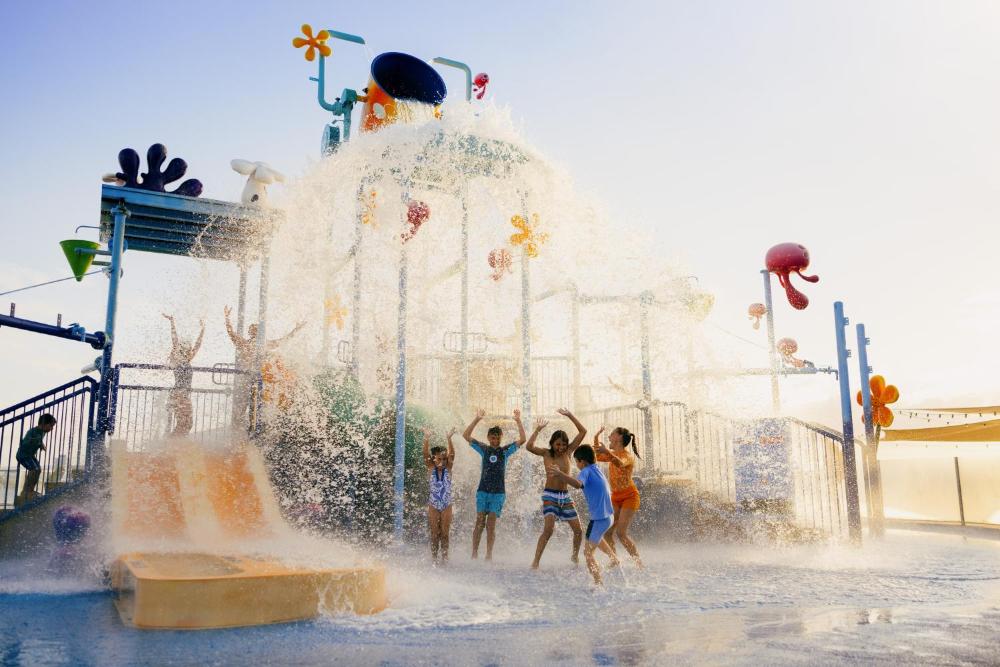
AquaPlay at Sea World.
Standard difficulties exacerbated by the pandemic
Stevenson recalls the unfortunate experience of operating a hotel with a mere “skeleton staff” during the lockdown years – which made returning to normality jarring.
“We came back to being a very full and busy hotel, and so we really struggled to recover the staff that obviously had chosen to find alternate work,” he says. “We had the workload ramp up, so that was something that’s recently been a big challenge.”
The difficulties of delivering a premium guest experience at an ageing resort are ever-present. Stevenson likens the process as akin to an “up-hill battle”.
He says 2024, so far, has felt like the first truly pre-pandemic year, due to the greater appetite for jobs, which was not experienced during the lockdowns or shortly after.
“When we advertised a job at our theme parks, we got anywhere from 60 to 100 applicants and then we went down to getting about three or four,” says Stevenson. “It was something I had never experienced before.”
The antithesis of a boring job
Stevenson is grateful for the opportunities offered to him as a facility manager, as it is a role with longevity and the possibility for promotion and ascendancy.
“A lot of the people that I started with 20 years ago have moved up the pecking orders to executive level or general managers,” he says. “I’m very lucky the people I work with and meet daily are just so lovely.”
Stevenson’s role as the facility manager of Sea World and Sea World Resort is the antithesis of boring and monotonous, with enjoyment and mirth ranking as high as The Leviathan’s peak.
Photography supplied by Sea World.
Bendigo Art Gallery’s Simone Bloomfield speaks of the ripple effects of a regional cultural space.


