
A range of challenges face companies when moving to a new location, but with expert advice and effective planning, unnecessary delays and headaches can be avoided and disruption minimised. HARTLEY HENDERSON explores the latest strategies underpinning moves to new premises. Some of the key considerations when planning a move include identifying what the relocating company can do for itself and what should be left to the experts, determining the specialised IT challenges involved (particularly in relation to the handling of sensitive and confidential materials) and establishing the key steps and timelines in managing the move.
Robert Hughes, national manager at Toll Transitions, emphasises the importance of detailed planning in ensuring a smooth and efficient relocation. He says that planning should include areas such as internal and external communication, risk mitigation, quality management, security, and occupational health and safety, as well as the development of a master schedule.
“The preparation of a communication management plan is a critical element in the planning phase. It should include a stakeholder needs analysis, an organisation chart for the project showing roles and responsibilities, a communication matrix for meetings and reports, and a detailed internal communications strategy,” Hughes tells FM magazine.
Derryk Guyer, sales director at Grace Removals Group, believes that the main objective when planning a relocation should be to minimise downtime for company staff by having the new work environment up and running without delay. “Key factors in forward planning that can minimise disruption include risk identification and management, and preparation of an effective relocation plan well in advance of the physical move,” Guyer says.
“At an early stage a space audit should be conducted of lineal metreage of papers and files in the current building and of available space in the new fitout. Records not required should be culled to off-site storage or scanning, and secure bins should be provided for confidential materials.
“Also, the majority of commercial relocation companies are not licensed to carry hazardous or dangerous goods, so the relocation manager may need to engage a specialist third party to undertake the relocation of such goods in accordance with state regulations. In addition, all relocation plans should include an effective insurance policy.
“While most large moves are completed after hours or at weekends, early or mini-moves in advance for facilities such as libraries can minimise risk and downtime. Key roles for the facility manager can include coordination of contractors, managing security and access in a multi-tenanted building, and ensuring that the lift contractor is on standby for major moves.”
Specialised equipment
Innovative specialised equipment is now available to reduce the workload for both the removalists and the client company. Steve Duroy, managing director of Movers and Shakers, says that after extensive research into methods of relocating, the company has implemented the use of security ‘Crates on Skates’ as the standard method of moving, effectively replacing the use of cardboard boxes.
“Crates are safer and easier for the client to use. They also add security for the items packed inside and are very durable, meaning they can be reused many times, with an anticipated life span of around 10 years. In addition, they are stackable, which eliminates crushing that can occur when using boxes,” Duroy says.
“Another advantage is that they are constructed from fully recyclable materials, making their use in the workplace environmentally sustainable and, because they are on skates, the need to lift heavy crates when packed is removed. The relocation process is also speeded up by eliminating the need for double handling, thus providing cost benefits for our clients, and each crate can be sealed with approved security seals to provide additional security.
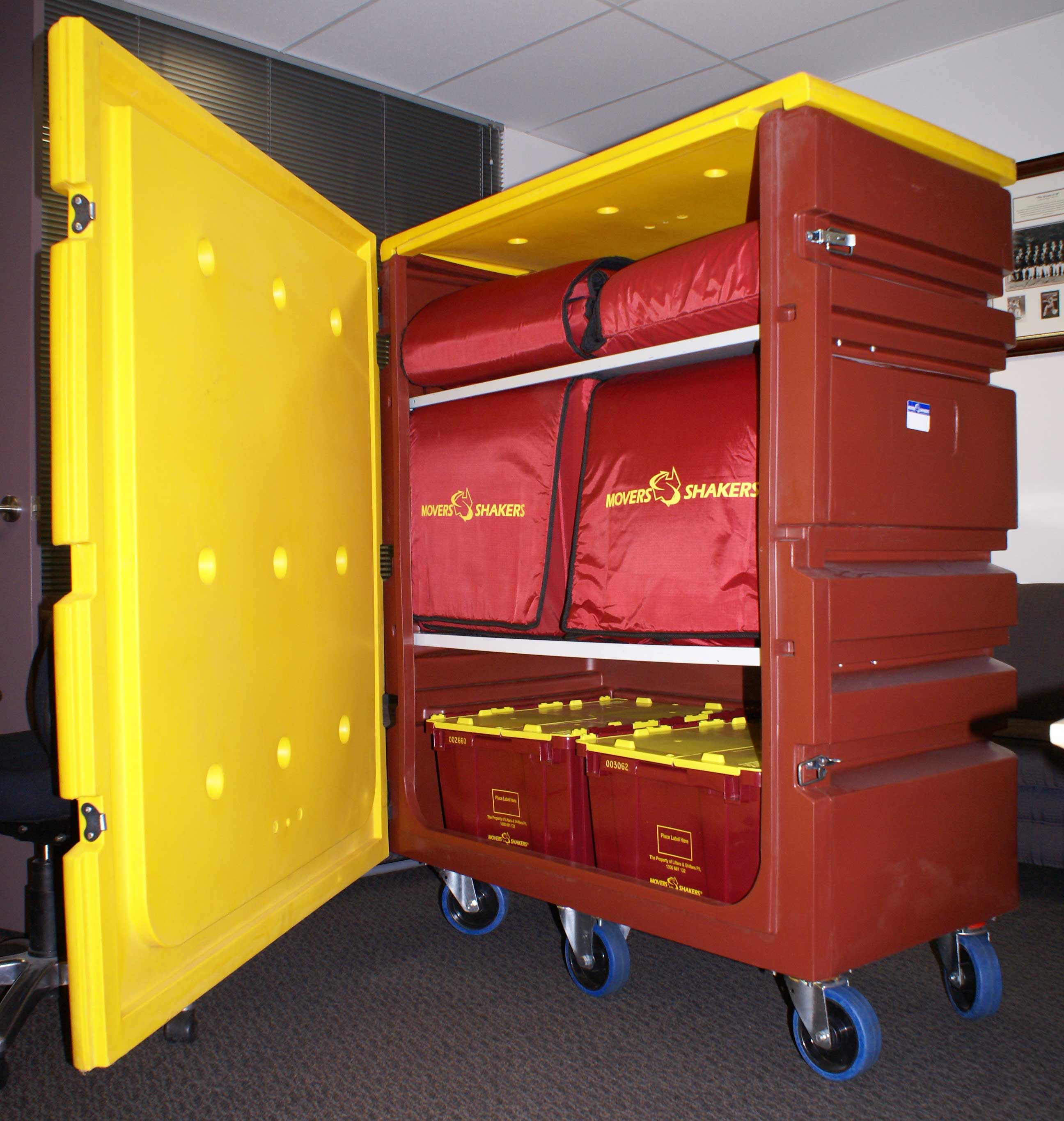
“Move Capsules are also available to not only ensure the protection of the items being relocated, but to also protect the environment through which they move. They are constructed of moulded plastic with rounded corners to reduce the risk of damage to surroundings.
“For ultra-high security moves, Security Crates can be sealed, placed in the capsule and the capsule locked. Move Capsules are also an extremely efficient method of relocating files and library materials, as they make it a simple matter to maintain the sequence of materials being packed and unpacked. The fully adjustable shelves and removable lid and door ensure that Move Capsules can provide the flexibility to accommodate items of all shapes and sizes.”
IT relocation
A critical element in most business relocations is the effective decommissioning and recommissioning of IT systems. This can include secure server transportation, IT inventory auditing for desktop environments, and reconfiguration and testing of hardware and software.
According to Lisa Barwell at ITFM Services, it is important to work closely with the client and the removalist in planning IT systems relocation, ensuring the conduct of a pre-move audit and addressing challenges such as determining the most appropriate timing for systems to be shut down.
“It is particularly important to plan a realistic timeline for relocation and to effectively coordinate the removal of all hardware items including desktops, laptops, peripherals, printers and servers,” Barwell says.
“Every detail should be planned in conjunction with the client’s staff, including the facility manager. We have developed a comprehensive process to accelerate decommissioning and recommissioning with a view to maintaining business as usual. A check-list is used to provide an as-installed snapshot of each workstation with the aim of mirroring each desk layout at its new location. All devices associated with the workstation are noted as well as any special cabling, and any complex cabling arrangements are labelled to ensure accurate reconnection. The check-list includes asset numbers, quantity, type and configuration of devices.
“IT system relocation projects undertaken by ITFM Services cover a wide range of aspects including one recent project where more than 1000 PCs were decommissioned and recommissioned in a 27-hour time-frame.”
Hartley Henderson is a Victorian journalist specialising in the building and construction industries.
** ALSO**:
RECORD-BREAKING MOVE UNDERWAY
The largest relocation in Australian corporate history, involving the movement of 10,000 ANZ Bank employees to new premises at 833 Collins Street, Docklands, is currently underway in Melbourne.
The move, which involves relocating from 12 existing sites to the new premises, is being project managed by Toll Transitions. According to the company’s national manager, Robert Hughes, a major challenge with any large relocation is managing the risk for the client, and central to this is ensuring effective communications with all key stakeholders and staff.
“Considerations such as the reduction of storage holdings, the data capture of all IT and related peripherals, and business unit-specific requirements, need input and actions from staff after thorough communication and advice to ensure that risks to business continuity are minimised. Scheduling the relocation of some 50 business units, many of which are dependent on others for their operational needs, takes careful and precise planning,” Hughes explains.
“Also, the expiration of leases on some ANZ properties can impact heavily on the timing of staged relocations and cause multiple additional internal relocations to enable leasing requirements to be met.
“In addition, experienced and competent third party providers of specialist services, such as IT systems relocation, need to be involved. The risk to the client organisation if any of these contractors were to fail to deliver could be substantial in terms of business and financial impact.”
