

As evidenced by the United Nations Sports for Climate Action initiative and the emergence of organisations such as FrontRunners, Footy for Climate and The Cool Down, sport has joined the climate action arena to highlight the impacts of excessive material consumption and extreme weather on the industry.
This Australian Open, Facility Management spoke to Tennis Australia’s director of sustainability Matthew Nicholas to discuss the organisation’s industry-leading and ambitious waste reduction targets and staunch commitment to social sustainability and environmental responsibility.
Every January, Australians welcome scenes onto their screens of lurid blue Melbourne Olympic Park courts, Jim Courier’s charming and self-effacing post-match interviews, the unwavering composure of ball kids and the emergence of a new hot young tennis player set to capture hearts.
Melbourne Olympic Park transforms over January and receives hordes of fans alighting from cramped Number 70 trams, who acquiesce to waiting in queues for street food and embrace hankerings for Aperol Spritzs. Melbourne is inevitably busier, and with more people – 1.1 million people are predicted to visit the Australian Open (AO) this year – comes more waste. Unsurprisingly, as one of the biggest sporting events in the Southern Hemisphere, the AO requires a hefty amount of labour to remain clean and safe.
The waste that comes from such events in a climate-conscious epoch begs the question – how can we future-proof cherished traditions and events that contribute to the social and cultural fabric of our cities? Is there a way to make small but meaningful changes and strengthen our communities and cities?
Eliminating single-use waste is a productive place to start. Tennis Australia director of sustainability Matthew Nicholas hopes such a feat will reverberate around the world to other Slam events.
“Hopefully the climate action programs we run can be easily found, easily seen and easily understood,” he says.
Sports for climate action
Through its waste reduction programs, use of electric vehicles (EVs), engagement with renewable energy and pledge to improve community outcomes, the Australian Open is an exemplar of environmentally responsible event management.
Tennis Australia was the first major Australian sporting organisation to endorse the United Nations Sports for Climate Change Action Framework. This framework maintains that sport can be used as a vessel to garner global solidarity in the fight against climate change.
Commitment to the framework offers organisations the opportunity to demonstrate climate leadership by forging partnerships and taking proactive steps to tackle climate change. Members are asked to adhere to five principles and embed them into practices, policies and procedures.
“We have a climate action strategy to deliver that commitment,” Nicholas says. “The climate action strategy has three pillars – reducing emissions, future-proofing and consuming responsibly.”
Tennis Australia has subsequently implemented a range of programs to ensure the AO upholds responsible consumption.
“The AO is where we have our most significant consumption, with 1.1 million people through the door each year,” Nicholas says.
“From there, we ask how do we reduce overall material consumption, and the materials that we do consume, how do we divert them from landfill?”
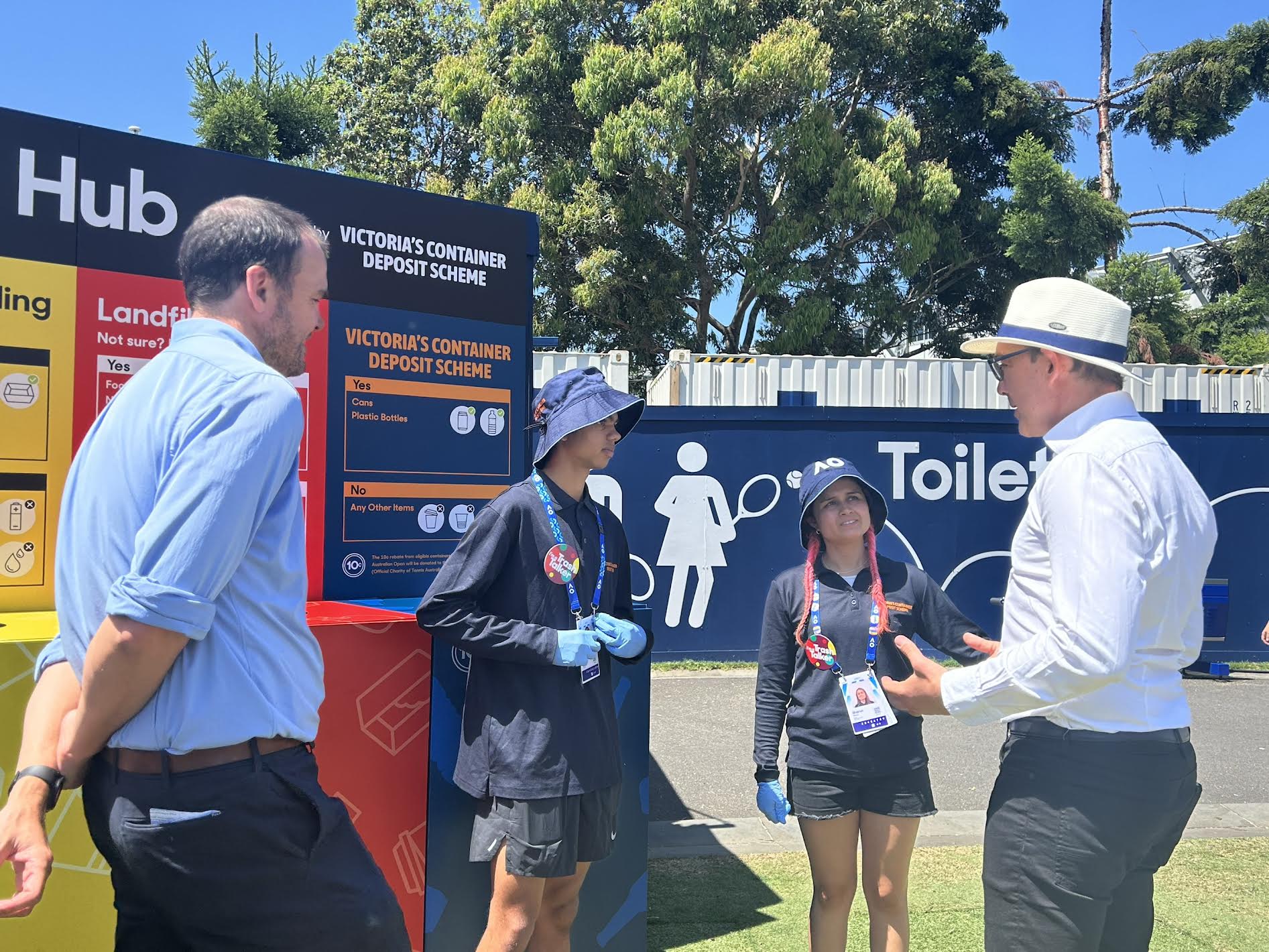
Tennis Australia’s director of sustainability Matthew Nicholas and Minister of Environment Steve Dimopoulos with CDS Vic’s ‘Trash Talkers’
Successful reusable initiatives
Nicholas says the AO’s reusable program is expanding every year, and while the program is still fairly small in the context of all the food and beverages sold on site, many vendors are embracing the rewarding opportunity to provide reusable plates and utensils to patrons. This year, Sustainability Victoria has supplied 38,000 reusable cups to various vendors.
“We have a number of vendors, including our new Courtside Bar that is only two years old and some of the popular food vendors like Tennessee Wing Boys and Good Days, that have reusable plates and bowls from Green My Plate,” he says.
Green My Plate supplies reusable plates, bowls, cups and mugs to an array of events venues, and last year, helped the AO reuse 73,000 items. This year’s reusable target is 100,000 items, which was achieved on Tuesday night, and Nicholas strongly encourages patrons to shop at these vendors and partake in environmentally responsible circular behaviours.
“This program means we can keep 100,000 single-use items out of waste by having those materials washed on site by Green My Plate” he says.
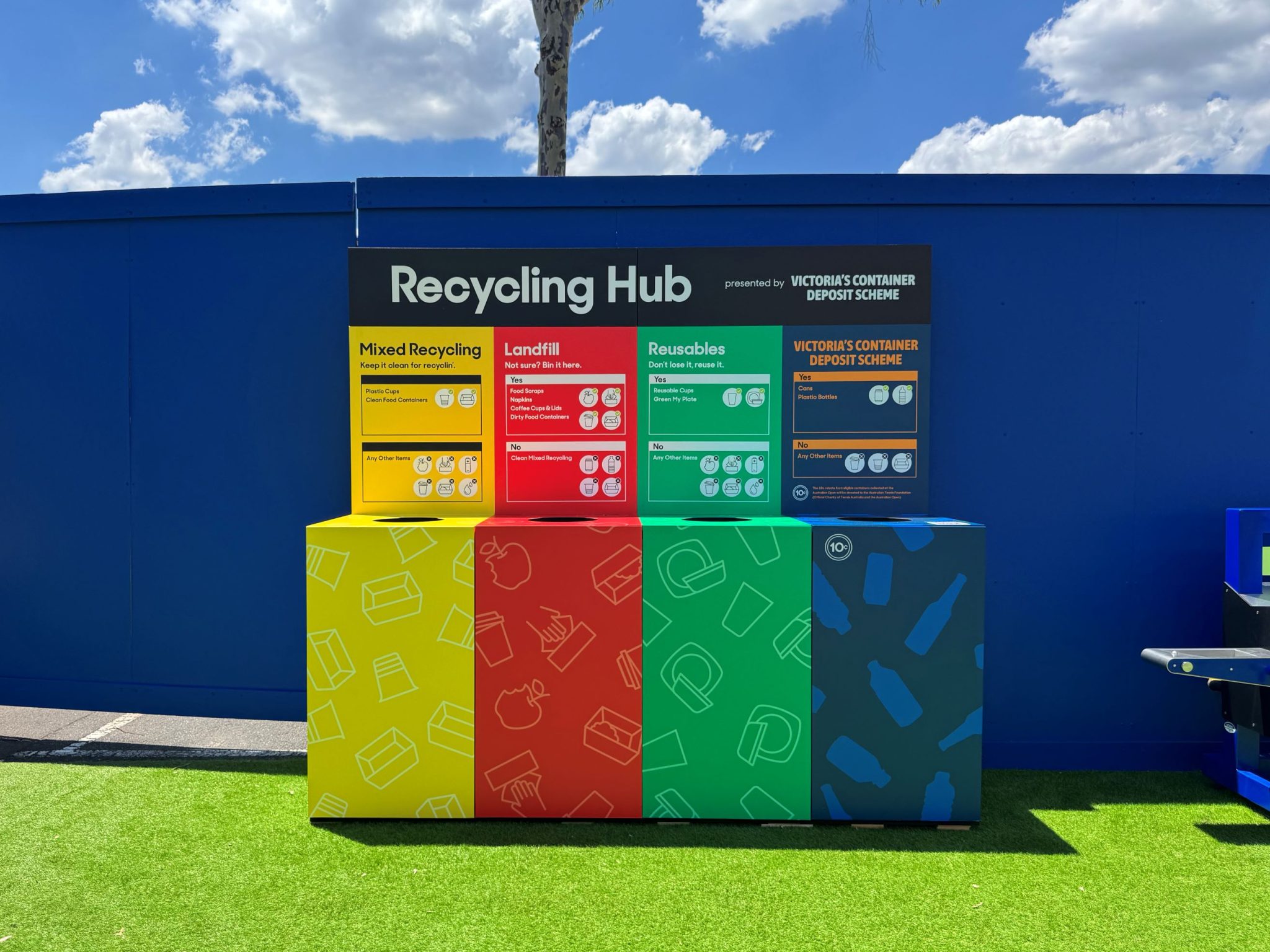
Recycling hubs are set up around the Park to divert waste from landfill.
Victoria’s Container Deposit Scheme
For the first time in AO history, Tennis Australia has joined forces with Container Deposit Scheme (CDS Vic)to redirect waste from landfill, spotlight recycling and reuse programs and support Victorian grassroots tennis organisations.
CDS Vic is fresh from a successful Christmas period, with 90.2 million containers returned between 16 December 2024 and 5 January 2025, putting $9 million back into the pockets of Victorians. A 10-cent refund is provided for every eligible can, carton or bottle returned. The scheme, which launched in 2023, has so far collected more than 1.3 billion containers and returned over $130 million to Victorians.
The achievements of CDS Vict are underpinned by the Victorian Government pledging $515 million to divert 80 percent of waste from landfill by 2030.
View this post on Instagram
‘Trash Talkers’ at the Australian Open
2024’s Australian Open saw the deployment of enthusiastic and eager ‘Trash Talkers.’
This army of recycling ambassadors is stationed at recycling hubs across the park to equip patrons with advice on how to return single-use waste and which bin to use for their waste. Nicholas says QR codes placed at the hubs detail information on Victoria’s Container Deposit Scheme and Tennis Australia’s official charity and CDS rebate recipient, the Australian Tennis Foundation.
“Patrons are informed that the rebates from the CDS Vic collections will go to the Australian Tennis Foundation (ATF), which is our charity of the AO,” Nicholas says.
The ATF offers support to young people facing disadvantage by enabling participation in tennis programs and partnering with youth and community groups.
At last year’s tournament, with the help of the ‘Trash Talkers’, Melbourne Olympic Park collected 886,192 containers to be recycled. This year, Tennis Australia is aiming for one million.
Nicholas says the ‘Trash Talkers’ also help in the waste compounds sorting and mining appropriate material to be recycled.
“They come in and get their hands dirty and divert that material,” he says. The efforts of the ‘Trash Talkers’ mean two or three skips brimming with recycled materials leave the park every night.
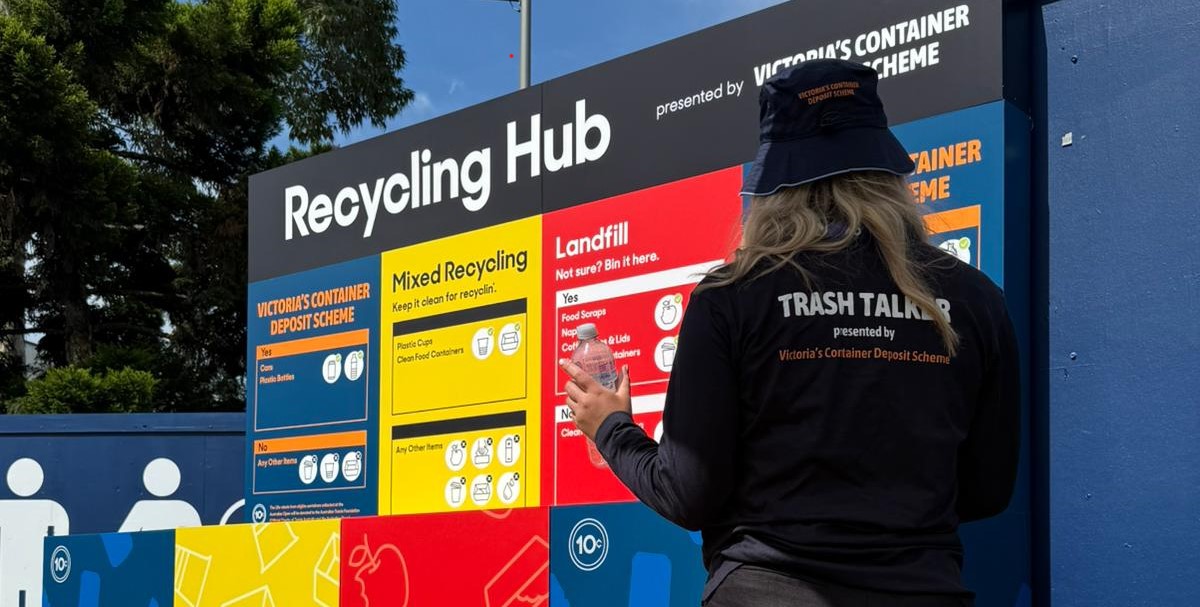
Trash Talkers are stationed at recycling hubs to equip patrons with advice on how to return single-use waste and which bin to use for their waste.
Facility management would be wise to adopt circular design framework
Nicholas says as the AO is a temporary build, Tennis Australia seeks to extend the longevity of its infrastructure. The AO operation differs from the year-round operation of Melbourne Olympic Park in terms of size, workforce, material quantity and volume, and its marketing partnership with CDS Vic.
“We’re working on a circular design framework on ways to extend the life of those materials and make sure we understand what is in our warehouse and how we can reuse those materials in a more responsible way,” he says.
Nicholas is hopeful the AO’s sophisticated and achievable waste reduction programs become a pillar of guidance to other facilities and events. VicReturn – coordinator of CDS Vic CEO Jim Round shares this desire for maximum social impact.
“The partnership at one of the world’s premier sporting events highlights the importance of environmental responsibility to a global audience,” he says.
“These initiatives will not only have positive impacts on the environment, but will support local communities.”
Rallying players for the sustainability journey
Tennis Australia’s adoption of circular design methods extends beyond waste reduction, as the AO has embraced the rapid EV uptake.
“40 of the 120 vehicles in the player fleet are EVs, and there’s another 10 vehicles used for the corporate fleet that are EVs,” Nicholas says.
Tennis Australia is also pursuing total renewable power by acquiring large-scale generation certificates to cover the AO’s electricity consumption at Melbourne Olympic Park. Such certificates are created for eligible large-scale renewable energy power stations and quantify the amount of renewable energy generated by facilities.
“We’ll surrender these certificates post-AO, so that will mean the AO is powered by renewables,” Nicholas says.
Moreover, in furthering the target to eliminate single-use plastic waste, players are provided with refillable water bottles from WaterDrop.
“We’ve installed additional refill points, including on every match court,” Nicholas says. “The players are provided with chilled and filtered Melbourne tap water.”
Industry-wide commitment
Tennis Australia is set to aim higher next year with the AO’s waste and emission reductions, accelerated by the organisation falling under Group One for mandatory climate reporting.
Nicholas anticipates organisation-wide reflection and continuous commitment to material and fossil-fuel reduction, and prioritising honesty when lodging climate action.
“We want to make sure that we’re robust and transparent with our reporting,” he says.

How can we make the cherished events that contribute to the social and cultural fabric of our cities more sustainable?
The current climate action landscape for sport is inspiring. Other mobilised bodies include FrontRunners, a climate change awareness organisation founded and operated by Emma Pocock that aims to safeguard the future of sport amidst extreme weather.
Following the Black Summer bushfires, Pocock spearheaded the biggest athlete-led campaign in Australia’s history into action, with almost 500 athletes from more than 40 sports demanding government action on climate change.
Tennis Australia’s plight to create future summers at the AO marked by zero waste and powered by renewable energy will hopefully propel additional sporting and cultural events into action.
Photography supplied.
Rod Laver Arena champions accessibility with world-class cool down facilities.


