

When attending a concert at a theatre, moseying around an art gallery or museum, strolling past your local community centre or experiencing child-like wonder at the zoo, do you stop to ponder who is in charge of the management and operations of this bustling facility?
In ‘Meet Your Local FM’, we talk with the facility and operation managers, technical service and safety operators, and sustainability officers of iconic Australian institutions.
We’re diving deep to reveal a facility’s inner mechanics, along with the who and what it takes to keep these special spaces running so smoothly. We’re putting a face to a facility and debunking any assumptions surrounding this essential profession, which many don’t know a lot about.
In the 1870s, there were more than 500 flour mills in pre-federation Australia, amounting to approximately one mill for every major country town.
Dubbed by historians as the genesis decade of the ‘First Long Boom’, which would last until the 1890s, the 1870s saw rapid urbanisation in Australia. People flocked to cities such as Melbourne – where one-third of all workers, both men and women, were in the burgeoning manufacturing industry – in pursuit of stability and a better life.
In 2025, Australia’s flour mill landscape looks a little different. Although Australia only has 30 flour mills – eight of which are owned by leading flour manufacturer Allied Pinnacle – the site manager of Allied Pinnacle’s Kensington site, David Liddell, bursts with uncontainable pride to be a part of the flour mill workforce.
“I’m very happy that I get to spend my time in this industry,” he says.
Hailing from across the Tasman, where he spent seven years working as a baker, Liddell raves of an “engaging and rewarding career” in the flour mill industry.
“I love the people, I love the flour, and I love the process,” he says. “And what we do is supporting the community around us: the local bakers.”
Owned by the Nisshin Seifun Group, Allied Pinnacle is a bakery business and reputable manufacturer of flour and bakery mix that employs approximately 2000 people across Australia and New Zealand. The company supplies flour, bread and cake mixes to large and small manufacturers and 2500 bakeries across Australia.
Baking the future from flour
Liddell relishes being involved in a symbiotic ecosystem and contributing to a broader picture. Baked goods that crowd shiny bakery windows, earn hot commodity status in sharehouse pantries or receive rounds of applause at birthday parties, originate from the work of people like Liddell.
He says it is immensely satisfying to start the ripple effect that ultimately equips local industries and businesses with flour. “I believe in loving what you do and doing what you love,” he answers when asked if a mantra guides his work.
While the site management of a flour mill is a niche speciality even for ‘Meet Your Local FM’, Liddell resonates with the standard experience of an average day in facility management being a fallacy.
“No two days are exactly the same, but there are definitely key responsibilities and routines that shape my day,” he says.
Liddell’s role encompasses team leadership and problem-solving and strategic planning to unlock operational efficiency for Kensington and the seven other mills in the group, located in Picton, Ballarat, Kingsgrove, Tamworth, Tennyson, Mile End and North Fremantle.
He is honoured to oversee a mill that is the number one practical mill in the Nisshin Seifun Group. Such an acknowledgment is indebted to site management and upholding the complexities and intricacies of milling.
“I have oversight of the quality logistics, wheat procurement and the milling process, which is hugely technical,” he says.
“We are baking the future of flour.”
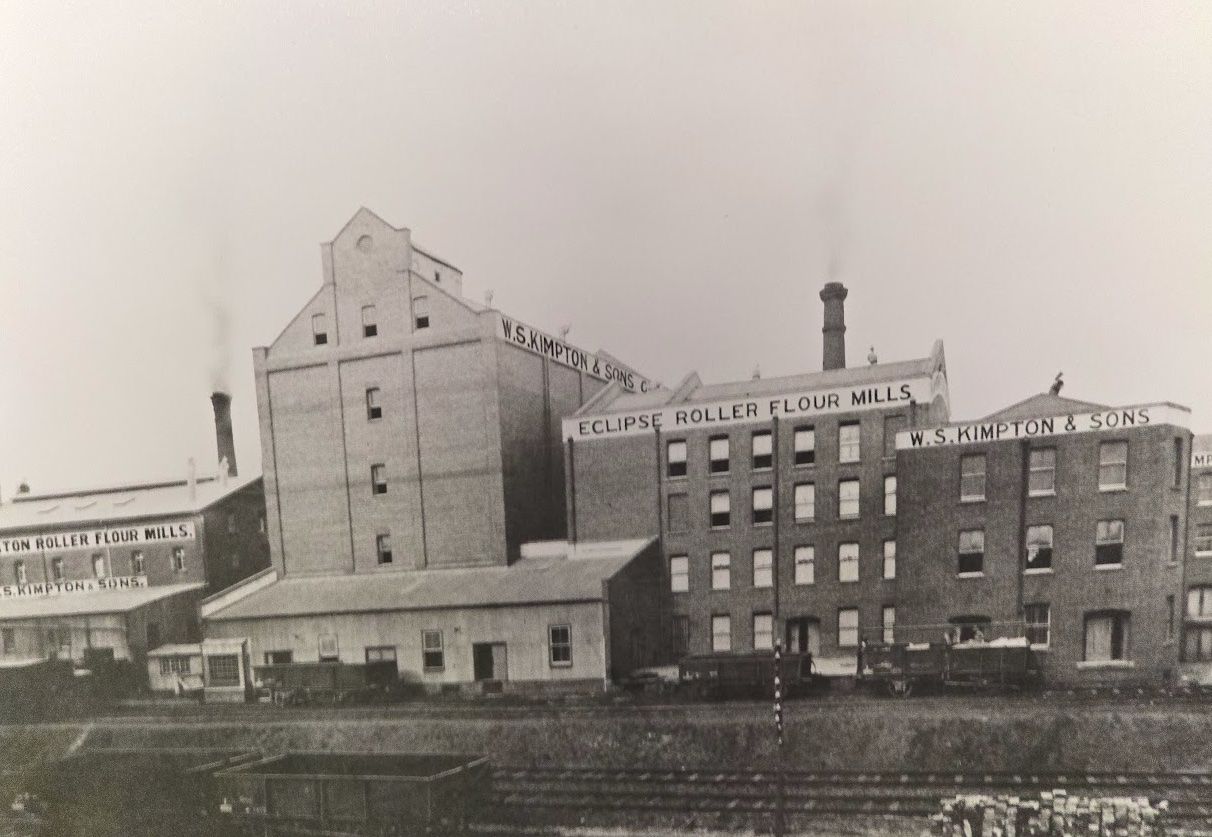
The Kensington mill in 1888.
The unknown and underappreciated intricacies of flour milling
Liddell cites a major challenge in Kensington’s site management is constantly monitoring the reliability of the complex equipment and refining supply chain management.
“Our mill has multiple storeys, like all mills, and we have screening machines, conveyors and roller mills,” he says.
As with many mission-critical facilities, unplanned outages and equipment failures can severely derail and disrupt schedules at the Kensington site. “Outages increase our cost to repair and can compromise the quality of flour,” Liddell says.
Liddell distills the wondrous process of flour milling into a comprehensible step-by-step process. Flour milling demands discipline, dexterity, precision and unwavering compliance to standards and codes. He addresses a common misconception of the industry is underestimating the technical intricacies of flour milling.
“It’s the same with every mill,” he says. “We receive the wheat, we clean it and make sure the quality is consistent.”
Liddell says milling is akin to grinding – breaking open kernels and extracting the endosperm from the inside, which transforms wheat into flour.
“It’s processed through different sieves by particle size and then put into a bag or a bulk tanker for a customer,” he says. “But the process in the actual milling stage can have up to 80 or more different rules and processes on how to turn endosperm into flour.”
Liddell says a ‘run to break’ maintenance approach at a flour mill is unsuitable and hazardous.
“A common misconception is that people think a flour mill can just run to break,” he says. “You can’t be like that in the milling operation.”
Similar to many facilities, preventative maintenance is imperative at Liddell’s Kensington site, alongside upholding safety and compliance and championing sustainability initiatives.
“Preventative maintenance means paying attention to machinery before anything breaks,” Liddell says. Preventive maintenance is cost-effective and extends the longevity of machinery at the mill.
“We check the temperature of bearings and the wear and tear, and then use that data to make sure we’re correctly implementing preventative maintenance to minimise failures, disruptions and extend the life of equipment, ultimately reducing our cost,” Liddell says.
The importance of upskilling in technical industries
Liddell wants to see millers receive greater recognition and credit.
“I think people don’t understand that flour milling is a highly qualified and skilled position,” he says. “They have technical expertise and they’re strategic thinkers. Their knowledge of the industry is very complex.”
Liddell beams when informing Facility Management of the career progression of Kensington’s production manager.
“We sent our production manager Joel to Swisse Milling School for six months and he’s now essentially a doctor of milling,” he says. “He came back with skills and took on a greater responsibility, and it’s incredibly rewarding to see.”
Located in St Galen, Switzerland, the Swisse Milling School welcomes more than 1500 grain processing students from 90 countries each year. Students are enrolled in subjects examining milling and machine technology, natural science, cereal science, nutrition science, pneumatics and electrical engineering, and pneumatic conveying and aspiration.
“I am very passionate about upskilling and making sure that our team members are top of the line. It’s so important,” Liddell says. “And seeing the team grow and impart information onto others when they come back makes me so happy.”
Battling a skills shortage
Liddell is delighted to play a part in contributing to economic growth and stability in Victoria and Australia. “We’re contributing to our community and feeding communities,” he says.
However, he identifies areas for improvement within the industry and is saddened by the skills shortage. “The skills shortage is exacerbated by the rapid evolution of technology, which demands new skill sets,” he says.
Although IoT systems, artificial intelligence and building management systems enhance convenience and efficiency, Liddell recognises they play a part in increasing the susceptibility of systems to cyber attacks.
“With automation comes a lot of good benefits but also risks,” he says.
Liddell hypothesises the skills shortage of millers also stems from an unclear and murky pipeline into the industry.
“It’s such a niche market,” he says. “It is not like your local electrician firm; there are hundreds of thousands of electricians in Australia. Millers are just not that common. The skill level is generally limited by the impact of our availability.”
Photography supplied.
Featured Image: David Liddell.


